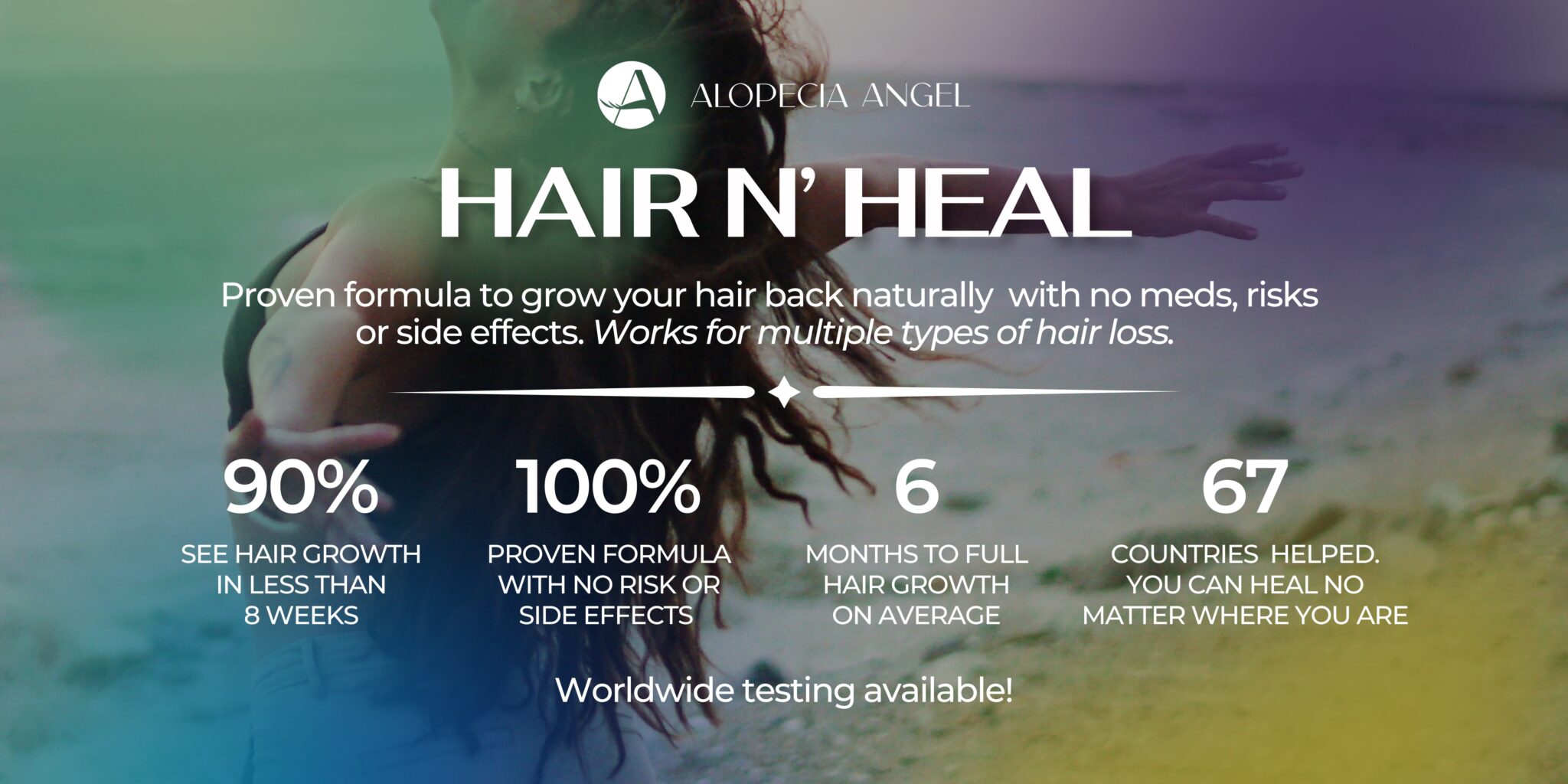
I wanted to start off today by talking about how healing is possible. I am absolutely convinced that anyone who wants to can choose to heal naturally from hair loss, from autoimmune diseases, from alopecia areata, totalis, and universalis. I believe it’s 100% possible. I’ve been doing this for over nine years, and I see this over and over again.
The most skeptical clients come to me. We start working together and all of a sudden they’re seeing symptoms from two years, 10 years, 15 years, even 30 years, alleviate within weeks. And this is not a testament to anything else but their body, their biology, which we all share, their willingness, which we all can have, their desire to heal, and of course the strategic approach and personalization within the Hair N’ Heal program.
I think more and more people don’t realize that healing is actually possible naturally. They think medications are the only way. I grew up in that generation where anything happened, you went to the doctor. Cough, cold, big or small issue—it didn’t matter.
But even in my own healing of alopecia, doctors didn’t really help me. In many cases, they didn’t have answers, and sometimes they made things worse. So I was forced to question, to explore, and I’m glad I did. I’m also grateful for the results of my clients, and my own journey, because it shows what’s possible.
If you know someone dealing with hair loss, who feels like they’ve tried everything and are on the verge of giving up, share this. We offer free trainings, PDFs, consultations, and real-life success stories.
New Research on Alopecia Areata and Mental Health
Today’s episode is about a research paper I came across that highlights something very important: the mental health impact of alopecia.
In a report by Randy Dotinga (March 27, 2026), new studies show the psychiatric toll of alopecia areata on women. One key finding is that Black women with alopecia areata are at greater risk for depression and anxiety compared to non-Black women. Women with scarring forms of alopecia are also more likely to develop psychiatric disorders than those with non-scarring forms.
Scarring alopecia tends to appear more frequently in the Black women community. It’s not something I commonly see in men, but I do see it more often in women across different backgrounds.
That said, we’ve worked with many women—Black women, African American women from Nigeria, the Caribbean, and those living in London—and they have seen results inside the Hair N’ Heal program, along with women from other ethnic backgrounds as well.
With scarring alopecia, timing matters. Once follicles scar, it becomes a 50/50 situation. The earlier you act, the better the chances of recovery.
A Real Example of Recovery
There’s a client named Danielle who shared her journey on my social media and YouTube. She has frontal fibrosing alopecia. Within about five weeks of the program, she saw around two and a half inches of hair growth, including in areas she didn’t expect to recover.
This is why early action matters. If you suspect scarring alopecia, a biopsy can help confirm it. But even then, I’ve had clients receive multiple different diagnoses from multiple doctors. Many come in confused, with conflicting information, and still see results once we begin supporting the body.
Scarring types include frontal fibrosing alopecia, CCCA, LPP, and others. Alopecia areata, totalis, and universalis are non-scarring.
Understanding the Research Findings
A study presented at the 2026 Skin of Color Society Scientific Symposium found that alopecia areata is more common in Black women. A 2023 study also found they are 1.35 times more likely to develop alopecia areata than white women.
Black women also experience traction alopecia, which can be linked to tight hairstyles like cornrows or updos.
In the study, Black women reported higher rates of anxiety (18% vs 8.2%) and depression (18.8% vs 10.2%) compared to non-Black women. They also reported lower hair-related quality of life and higher anxiety symptoms.
Another larger analysis of over 42,000 patients found that those with scarring alopecia had higher rates of anxiety, depression, sleep disturbances, and insomnia compared to those with non-scarring alopecia.
These findings also suggest mental health burden may be underreported in some groups due to stigma or cultural factors.
Shifting Perspective: Healing Is Still Possible
What I find important is not just the data, but how we interpret it.
If we shift from limitation to possibility, we start to see something different.
Healing, in my experience, is like learning something completely new. When I was healing my own alopecia, I didn’t know how to do it either. I had to learn, experiment, and figure it out step by step.
Most people don’t have the time I had—I was able to focus on it full-time. That’s why a structured, personalized approach matters.
Healing requires a beginner’s mindset. Just like learning to ride a bike, drive a car, or learn a new language, you start from zero. You learn. You adjust. You improve.
And I’ve seen this repeatedly with clients across 68+ countries. Once people commit and follow a personalized approach, results follow.
Closing Thoughts
Healing is possible. It doesn’t matter how long you’ve had hair loss, your age, or your background.
What matters is action, consistency, and the right support.
If you’re ready to begin, visit alopeciaangel.com. We offer free trainings, resources, and consultations to guide you through the process.
And if this message resonates with you, share it with someone who needs hope.