This time we’ll revisit a previous episode with Sharon Sayler from The Autoimmune Hour! In this episode, we’ll explore natural healing approaches for autoimmune alopecia, identifying triggers, the differences between medication-induced hair loss and autoimmune. This episode is packed with key insights for true healing.
The Autoimmune Hour: www.understandingautoimmune.com
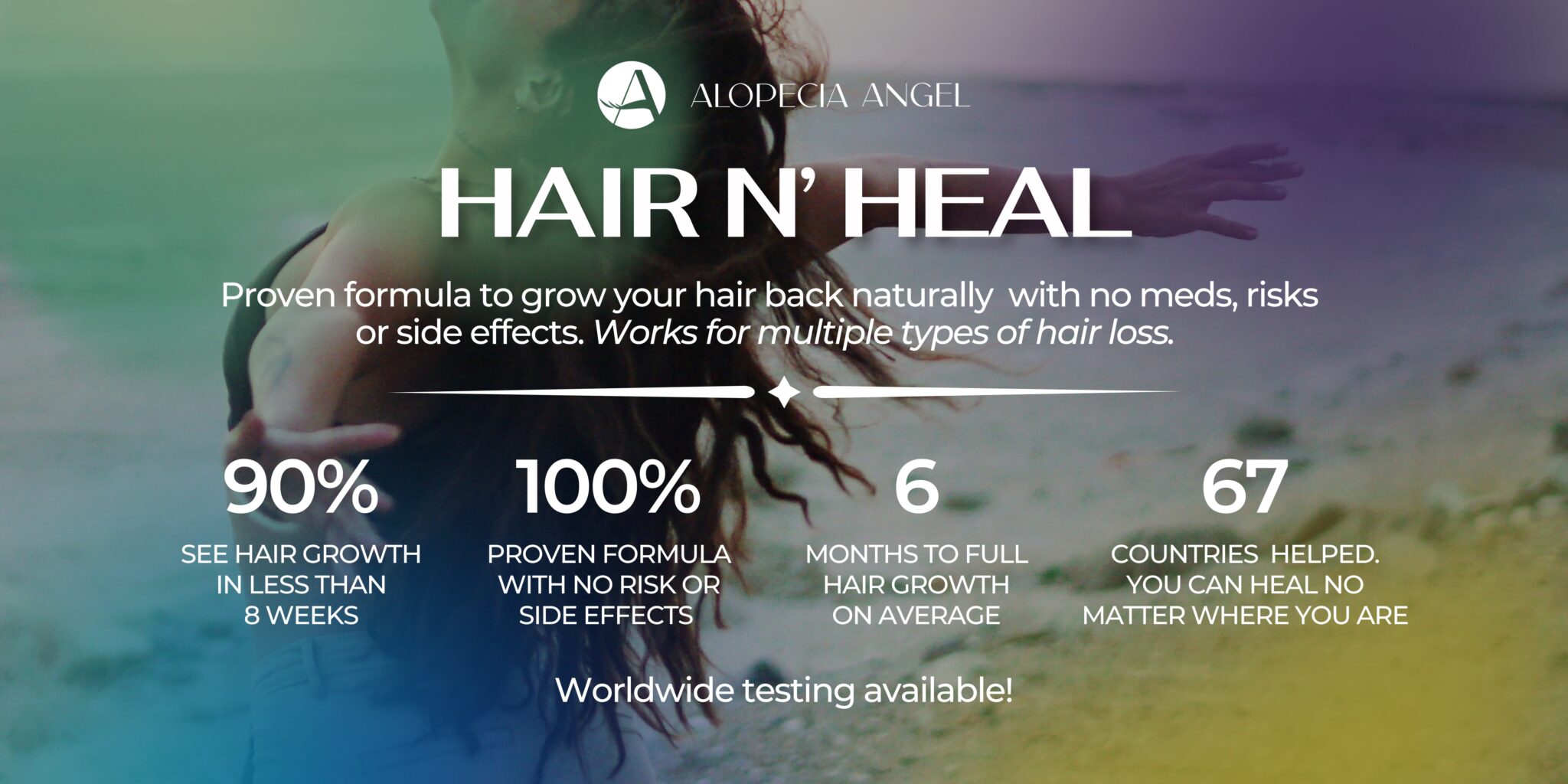
If you’d like to take the next step in your hair journey, Johanna is offering a free Hair N’ Heal Program consultation. This is your chance to ask questions, explore the program, and see if it’s the right fit for you. Spots are limited, so schedule your complimentary call here.
Check out our Free Downloads to learn the truth about Alopecia
Enroll in our Free Training Heal and Reverse Hair Loss Naturally in 6 Steps — discover how to restore balance naturally and support healthy hair growth
Connect with Johanna for a one-on-one session and receive personalized guidance on your healing journey. Schedule your consultation here.
–
HELP IS WITHIN YOUR REACH!
Alopecia Angel is dedicated to those seeking a holistic, natural, and safe approach to healing Alopecia from the inside out! The main force behind Alopecia Angel is a deep desire to help individuals achieve what I achieved with a natural treatment option, a well-rounded approach to health, wellness, and reversing Alopecia naturally without antibiotics, pharmaceuticals, cortisone shots to the head, or embarrassing creams.
After seeing results with my multi-tiered natural Alopecia treatment, targeting mind, body, nutrition, environment, and other elements, I decided I wanted to share my findings and let others know that a natural, safe, and holistic method does in fact exist to regrow hair from alopecia.
TRANSCRIPT
The information provided on the Autoimmune Hour Understanding Autoimmune and Life Interrupter Radio, including the websites plus social media, is for educational purposes only. What you read here and see on the Autoimmune Hour Understanding Autoimmune and its websites and other media outlets is based on experience only. The information should never be used for any legal, diagnostic or treatment purposes.
Sharon: So welcome, Johanna. Thanks for being on the show.
Johanna: Thank you so much. It’s such a pleasure and an honor to be here.
Sharon: And I must say no one would know that you have healed yourself from alopecia. If you’re on the videos, guys, she has amazing head of hair there.
Johanna: I’ll let you know. It’s truly not a wig. You can see all of it right there. The grays and all included.
Sharon: I’m so thrilled that you reached out to us because this is exciting to talk about. I have several friends with alopecia and it ranges the gamut from struggling really hard to overcome it, to embracing it. I did have hair loss. I don’t think it would be qualified for alopecia, but early on some of the medications they gave me to get my autoimmune condition under control caused hair loss.
One of my frustrating things then was the lack of education that my particular medical professionals had about hair loss. One of them even went so far to say: That doesn’t happen, and I was like: What? You think i’m like pulling my hair out? So that was really frustrating. Can you talk a little bit about what triggers alopecia and what is different between the medication induced hair loss versus alopecia.
Johanna: That’s a big question. We have a free PDF about the medications that cause hair loss. So that’s a nice little cheat sheet for anyone who is on medications. That’s like kinda like the first step in looking to seeing: Okay how can I go about rectifying my own hair loss? Because many times, let’s say if you’re on medications, and yes, there could be side effects and yes, it could be hair loss, but it doesn’t necessarily have to be autoimmune, right?
It could just be regular hair loss. Whether that’s telogen effluvium or diffuse or overall shedding, or potentially it could trigger, let’s say the androgens and your whole like female pattern baldness. So it just all depends. But if you are experiencing hair loss of any sort or any type and it’s already too much for you, because we all know how much too much is compared to our normal baseline, then I would say start there. Start looking at your medications, at your supplements. becaue many times they have ingredients that are not necessarily for you. Medications and supplements, if you think about them they’re a one size fits all opportunity on a store shelf.
And so this is something that you need to be very cognizant of and potentially you will have a side effect of, or maybe it will cause something else, whether it’s an upset tummy or hair loss or dry skin or anything else that this medication or supplement might have. And so that’s always something to review first and foremost. Because it can also have a bad interaction, right? With another supplement or with, let’s say, another tincture or what have you that you’re taking. And so this is also something to be mindful about.
But when it comes to hair loss in general, or the autoimmune, the triggers in general are vast, and it’s never just one thing. It’s never just one thing. Working with so many different clients for the last 8 years. I’ve seen that even if we all have autoimmune alopecia, whether it’s areata, totalis, or universalis the reasons behind that. On top of it, the person who’s going through it are all so different. What I like to say is that autoimmune alopecia and hair loss in general can also be put into this same category. It’s like a puzzle and you have a thousand pieces, and so it’s up to the person who you’re working with. In this case it would be me if you’re working with me, to put this puzzle piece together for you.
And you do that by assessment, you do that with an intake form. You do that with, you know, questions and answers. You do that with really understanding the person, where they’re coming from, their past, present and future goals. And then really putting this together in a personalized plan. Because really that’s the only way. We all have blind spots and I think more than just what triggered it. It’s what is it that I don’t know that’s keeping me from healing? I think that’s the bigger question, because for example, when I was going through my own journey, there was little blind spots and big blind spots here and there that I was coming across that I didn’t realize that they were holding me back.
This piece of it is extremely individualized. And I say this because I’ve actually helped nurses and personal trainers and doctors and functional medicine doctors and dieticians, nutritionists do my program for their own hair loss. And again, it’s not necessarily based on the education, it is that something is hindering us and we don’t know what it is.
So for example, I recently was working with a gut health coach. She works with numerous clients. She’s been doing this for 20 years, she’s in her mid to late 60s, she’s had hair loss for over 20 years. She’s never figured this out. In 24 hours, no exaggeration here, in 24 hours her hair loss stopped with just a handful of
recommendations that I gave her. And so from there, her body clearly was already primed for a lot of these changes. And so once she implemented them, then she was able to stop the hair loss, and then go into the hair growth cycle. That’s sometimes even the hardest part.
Sharon: I think that’s true with any autoimmune condition. Several things that you said about blind spots and stop the progress and then we’ll go into the recovery mode. I know with mine, the skin condition where my skin looks like third degree burns and peels off when it was in the worst phase, so obviously it’s okay. Stop the fire, put out the fire first, and then go into what is my next step after that is really good advice for anyone with an autoimmune condition. It’s interesting too that about the puzzle piece, and have used that analogy myself, except I say it’s like all your puzzle pieces are upside down.
You might have the picture of where you wanna go from a previous you or whatever. But I like to say creating a new picture for ourselves as we go forward. Because some of the things I was doing consciously or unconsciously led me to at least be susceptible to what happened in my immune system breakdown. Have that picture in our mind, but have it in the new revised format. When we first met in our off recording comments, one of the things you mentioned was everybody’s not the same. It’s not a one size fits all, and so I think that’s important for us to know. Let’s go back a step and say: Instead of even having a diagnosis, what is normal hair loss? I notice in the winter I get more hair, and in the spring and summer I tend to shed a little bit like my dog.
Johanna: This is a challenging question to answer only because if we were to do a quick internet search would tell you 75 to 150 hairs a day is normal. However, what I like to say is that you know yourself better, you know exactly what your shedding looks like and what that normal looks like as well. So if it’s too much for you, then it’s already too much. You don’t need Google or anyone else to tell you different. You already know, deep down your gut is already telling you that it’s already too much. And this is how I also knew that something more was wrong.
At the time, I actually had 2 types of alopecia. It was areata and then it was also the diffuse, so it was telogen effluvium as well. And I was clogging up drains and I saw hair shedding all around as if I had a dog, and I never did. I would see this on my yoga mat and I would see this in the kitchen and when I was cooking and it was just like overwhelming how much hair loss that I had never experienced something like that. And so because of that, I already knew it was too much and I knew something needed to be done as soon as possible. There was no more denying it. Even though it was in my face, like I still had a little bit of denial like: Oh, this must have been from somebody else, but no one was coming into my home. It was just me, you know what I mean?
I think denial plays a big part of also trying to say: Okay,, yeah, I do have a problem and let’s move forward and let’s get some help. I think sometimes that’s also part of it. When it comes to hair loss in general, like I mentioned before, the internet search will say anywhere from 75 to 150 hairs, depending on the article that you’re reading. It could have a seasonal effect to you depending where you live, whether it’s a northern
hemisphere or a southern hemisphere, or maybe you’re along the equator or maybe you are in an area that gets less type of, of sunshine or sunlight. But what I would say is that you can always upgrade and you can always, I like to say biohack as well, your hair health and your hair growth.
So for example, in my 20s and especially my late 20s, my hair wasn’t as great as it is now. Going back to your comment of when people say: Oh, I wish I was back to normal or back to the way I was. At one point I used to think that, but now I’m actually better than what I was before
Sharon: Bravo. That’s my way of thinking. It’s okay. That’s a starting point.
Johanna: Exactly. And so now at 44, I grow an inch of hair a month, which is also above what any internet search would say. Internet searches say it’s half an inch at most, but I’m doing an inch, and I can track this with my highlights and with my gray hairs that peak out, and every 6 weeks I’m in the salon redoing my hair. The hair growth density, the texture, the thickness, the fullness is so much better now in my mid 40s, than it was in my late 20s. That’s a big contrast to who I am now and to who I was then. Then not knowing what was happening and what was going to happen and just a few years later and the trajectory of that.
But there’s always ways to improve. I always get inspired when I see 80 year olds doing marathons or lifting weights or doing championships or doing all kinds of things that you would maybe assume that somebody much younger would be doing. And yet they’re doing it. And I love to see people define the odds and breaking barriers, whether it is in hair growth and health and sports, or in any other industry. I think that when it comes to our health and to our hair growth, it’s never too late. It’s like learning a new language. It’s never too late to learn French, it’s never too late to travel, it’s never too late to accomplish our goals, whatever they are.
Sharon: Now, I’m gonna go a little sideways, and this is probably more of a general type question. Something I found interesting is as far as the care of the hair that we currently have. I’m totally confused on how to take care of my current hair situation, let alone regrow hair. But I just wanted to go a little tangential here. I’ve looked at the ingredients on the back of many haircare products that are available in retail stores. It has so many ingredients. I’m overwhelmed and I just always put it back on the shelf because I’m like: Okay, I don’t know what to do. Are there simple things that people can do to maintain their current hair, and then we’ll dive more into what happens when you have alopecia and the things we need to do for that?
Johanna: Sure. The natural hair care product situation is possible to do it at home. I personally make my own shampoo at home. And the shampoo is a basis of like green tea and olive oil and a bunch of other pantry items that you can get. I’ve been using this now for over maybe 8 years, 10 years now. My son uses it, my husband, the whole family does. We travel with it. It never expires and it’s chemical free, and so I know exactly what’s going into it. So one thing is you could start making your own hair
products. If you don’t want to, there are certain brands that have a more organic tendency, and so I would search out organic brands, more natural brands that may be more beneficial.
But then also you need to ask yourself like, what are the symptoms of your hair? Is it too dry? Is it not lifting? Is it lack of volume? Is it too oily? Is your scalp too dry? Is it itchy? Like what are these symptoms? And then how can we mitigate them? Because sometimes you can add in different types of essential oils or add in different ingredients into let’s say your shampoo or your conditioner, and it will relieve a lot of these other ancillary symptoms that are going on. But then the other thing too, is to take into account is that our diet also plays a big part of what’s happening on the outside.
There’s a lot of myths and misnomers when it comes to hair loss or even hair growth, and age happens to be one of ’em. I have clients up until 82 years old in my program and they see hair growth, and so it’s not about age. It’s about how we support ourselves at the different stages of life. Because again, you know, trying to personalize a program. For example, for a 5-year-old is gonna look different for the 50 year old or different for the 25 year old. We’re all living different lives, different routines, and different situations. This is why personalization is key to seeing the results that you want.
Because even if we all had the same type of hair loss, we don’t all have oily scalp. We don’t all have a second or a third autoimmune disease. We don’t all have maybe joint pain or maybe brittle nails or maybe acne skin. It’s all gonna look a little different. The diet and the lifestyle component is massive, but then also when it comes to targeting your personal situation with hair, there are different ways to settle. For example, the oiliness, the dryness, the itchy scalp, or what have you.
Sharon: It gives me hope. Getting back to the actual alopecia, who do we seek out if we think we have a hair loss problem? And how is the alopecia diagnosis made versus, I’ll say hormonal hair loss and things like that. Is it difficult to get a diagnosis?
Johanna: When it comes to hormones or even thyroid, because hormone and thyroid play off each other, especially in women a lot more. What I would say is that, that type of hair loss will look a little different than the autoimmune alopecia. And that’s not to say that hormonal thyroids can or cannot be a factor for the autoimmune. They can, but more than likely it’s not the full picture either. If that makes sense. It’s just two pieces of the puzzle in the big scheme of things. And so when it comes to hormonal, or let’s just say autoimmune diseases as they can piggyback off each other.
Alopecia likes to piggyback with Hashimoto’s or Graves. Alopecia also likes to piggyback with rheumatoid arthritis, and so it’s very common to see somebody with hair loss, even if it’s not autoimmune and one or two other different types of autoimmune diseases. So I’ve seen, let’s say female pattern baldness and Crohn’s and IBS. I’ve seen female pattern baldness and Hashimoto’s, and so a lot of times people are coming to me for the hair loss, but then they also have other types of autoimmune. So it’s not
just the autoimmune alopecia that they come to me for. Does that answer your question?
Sharon: It’s just confusing. because hair loss can be caused by so many things, including, as I previously said, some of the medications that you’re given to arrest the symptoms of a different autoimmune can cause hair loss.
Johanna: 100%. I actually have another PDF on my website that talks about all the hair products known to man, that we’ve seen and know that are available at our stores that have been in lawsuits. That have known to cause hair loss in thousands of people. It’s not made public or it’s not making the headlines I should say.
Sharon: I don’t think it’s ever been talked about all that much, especially with females. Obviously the common one is men and hair loss. That’s the common one. I’m gonna go tangential again too, because you’ve just triggered another question in my brain. Yeah. My community knows that I kind of like wander around, but here’s a rabbit hole that I’d like to know. One of the things that happened to me, and I’ve heard the term before. People called it chemo curl when my hair came back and mine was caused by one of the medications they gave me to arrest my autoimmune condition.
Once I got off of that, the hair started growing back and things, but it came back completely different. I don’t feel like I’m the only one that’s said that it didn’t come back as the hair it was.
Johanna: That’s hormonal. So for example, when I hit puberty, I got my curls, and then when I was going through alopecia, it became like a straw broom. It was the most ugly, unmanageable head of hair ever. On top of it, I was mulching everywhere, so that didn’t help. But then after now my curls are back. And so a lot of times I like to say that it’s hormonal because it does play an aspect of your hormone. Even with women who go into menopause, all of a sudden they’re seeing more wave and more body to their hair, and that’s definitely possible.
The other side of that too is also your environment. When you live in a humid area, like let’s say Miami, Florida, you’re gonna have more humidity, more volume, different aspects of your hair. And so the environment plays also a part to, let’s say, if you live in a place in the desert versus a tropical rainforest or near the beach versus the mountains. This will also affect your hair, how it curls, even for those of us with naturally curly hair. But even post chemo or post anything else that curl or that new hair might have its own flavor and texture and everything else, but you can help it because it is still on the healing path, especially when you’re recovering from chemo, you’re still on the healing path. You’re not necessarily out of the woods, your body’s rebuilding itself from all the treatments.
Sharon: I actually like the hair that came afterwards better. My hair is straightened right now, but it did get the curl and it still has the curl, and I’ve been off the meds for a number of years that I’m pretty sure it’s out of the system now, but what’s fascinating to
me, I also wanna backtrack a little bit. You triggered a thought, and that’s what I love about the show. It’s like: Oh, well that’s interesting.
About 2 years before my actual diagnosis. I mean, I knew something was wrong, but it was, it’s often a journey to find the right diagnosis. I did get that straw like hair. I was recently going through some old photos and I was like: Wow, look at my hair back then, and your comment about straw like hair just triggered my mind back to that photo, which I know was taken about 2 years before my diagnosis. That’s interesting. Can we use hair changes when we go to doctors and say: My hair’s not the same?
Johanna: Let me go ahead and answer this question along with the other question. Because I don’t think I actually fully responded. You had asked me what doctors should we be seeing. I think in all honesty, I have a big respect for doctors, for all the education, but that was probably one of my biggest mistakes, is seeing doctors. I spent and wasted a lot of time, money, energy, resources and flying around, seeing doctors in Europe, in Denver, and also in California. Because at the end of the day, they either had nothing to offer, except for limiting beliefs, or they had a bunch of pharmaceuticals to offer me, which is something that I didn’t want.
At the time of my diagnosis. I had just met my husband. We wanted to start a family. We wanted to have kids. I was in my 30s, and so that runway was getting shorter and shorter. And you know, here I am with alopecia as a diagnosis and you start researching everything online, and it seems like it’s a black hole of sorts with no light at the end of the tunnel. When I started going through forums and online groups and everything, it was just very dismal of what I saw. I would say ask questions first. Ask: Do they have results? Do they have results? Testimonials, before and after pictures.
Just like if we were gonna go get any type of plastic surgery done, or if you wanted to get your house painted, and before investing in somebody to redo your house or construct a new house for you. You wanna see before and after pictures and maybe even talk to some of their past clients, look at testimonials, and now I’m holding doctors accountable in the same way. So if you want to see a doctor understand that they only have 2 options, it’s really the pharmaceuticals or nothing like I was offered in Europe.
And so there’s no really happy middle ground. And so find somebody who can show you results and who can get you to the finish line. I also like to use athletes as a comparison because even if, let’s say you have the sport, let’s say basketball or football, and you wanna go pro. That high school coach is not gonna get you to go pro. The college coach doesn’t have the experience to get you pro, and it’s really the professional coach who does and who can see the talent in you. And so that’s the difference of tiers and that comes with experience, that comes with expertise, that comes with having the years of investigation and really understanding your niche of the breadth of the situation at hand, and not just putting the person in a box.
My experience, just like the majority of my clients, is that they’ll go to a doctor to go see for hair loss, but then they’re like: Oh, you have female pattern baldness. These are
your options. It’s all these topical stuff, or maybe oral. If you have autoimmune, these are your options, and you have JAK inhibitors and you have pharmaceuticals and cortisone shots, and the list goes on with immunosuppressants. If you have telogen effluvium, well you know, go do some yoga and de-stress because I have nothing for you, except if you wanna get on the topical stuff, just like the female pattern baldness.
And so putting the people into boxes with different pharmaceutical or topical treatments is a disservice to anyone with hair loss, because normally hair loss, what I like to say is the tipping point. There’s more to it. It’s the check engine light that we should be aware of that more is underneath. We should be looking at more instead of just thinking of this as just a superficial situation that we can go to the drugstore and buy some shampoo or some serum and like our worries are gonna go away because more than likely they won’t.
Sharon: And to that point, what are some things that are very common when you are working with people and are that second layer, third layer, or fourth layer after they say: Okay, hair loss? What are some of the things that you start looking at right away, like diet or lifestyle things.
Johanna: I ask a lot of questions in regards to diet, lifestyle. I ask a lot of questions in regards to their history, to other health concerns, to their health goals. I had a client who was breastfeeding and so she had alopecia areata and she was breastfeeding, and so she didn’t want this treatment or this plan or this program to hamper or hinder her breast milk production and so on. The program that I put her on, she was able to lose the baby weight, which was a good 30 pounds plus see hair growth, which she shows, because this is a podcast interview, she lifts it up and she shows that all the hair growth is coming up. And she said that this was bald for 4 years.
So she had it covered here, but underneath, if she lifted up the flap, you would see it was all bald. And so, it had been four years, and now finally for the first time in just 4 weeks, she started to see the hair growth. And so this is amazing progress that people can see and feel and have once they get a tailored personalized program for them. Because when you have that one size fits all mentality, which most people are educated on. You know the doctors, hence no real results with medications except for maybe lowering your symptoms, but really not getting you to the finish line of full health, full vibrant health where you’re off all medications and you’re on your own and your autoimmune is in remission. This is the key.
That’s where we all want to be full remission. I’ve been in full remission for 8-9 years now, and I know I don’t need or have to go back. I know it’s possible to be this way. Even better than when I was in my 20s, because now it’s like I have the answers, I’ve truly done it all, and I keep just progressing in the area. So for example, I like to say that when we do more for our health, it’s like our investment, our bank account or savings, right? It just keeps on compounding. So the more you do it and the longer you do it for, the better it is.
Sharon: Are there common triggers in someone’s diet that you’ve noticed?
Johanna: For autoimmune for sure. For autoimmune, for sure. There is. And just to preface, I work with people who are vegan, who are already, let’s say gluten-free, who already have you know, different dietary situations, let’s say like they fast for Ramadan. I’ve dealt with many people who are meat eaters or standard American diet or anything else across the gamut, or even those that are in Europe or in other places where you think, and we assume that food is healthier and let’s toxic and this and that. I will say diet is important, but it’s not everything. It’s very rare that I see somebody heal from diet alone. It’s not gonna happen.
There’s so many more factors, just like that puzzle piece analogy. There’s so many more puzzle pieces where I feel like a lot of times the media or the marketing aspect around autoimmune is really focused heavily on diet.
You know, being gluten free and being dairy free, and being this free and that free. And yes, that can be true to a big, high extent, but if you’re not supporting that with all the other areas, then you’re gonna be disappointed. You know what I mean? Because it’s not all or nothing and it’s one of many factors that need to be included.
Sharon: Oh, absolutely. One of my big frustrations about the autoimmune medical community is it’s mostly centered around either pharmaceuticals and or diet. And I meet so many people on the show that are down to a handful of foods and they’re still not well, and you can tell like they’re not eating enough of a variety in nutrients, etc. They’ve been told to eliminate this and that, and pretty soon they’re down to nothing, which is in my mind worse than having a larger variety of food. It’s so sad that there’s all this focus on one magic change to my diet and my hair will be fine or my skin will be fine, my body will be fine.
Johanna: And that’s just it. You know, it all depends on our past, present, and future. It’s all gonna look different because of what’s happened. For example, I have a friend of mine where she’s been exposed since she was a kid, to so many different things, which has, she has Hashimoto’s. She doesn’t necessarily have alopecia, but it’s compounded into her today being 30 something years old and having Hashimoto’s. And so that’s her journey and she’s healing from all these numerous things ever since she was a kid. That journey is gonna look very different from someone who, let’s say in their 30s or in their 60s or in their 20s, just discovered that they have alopecia it. Sometimes you have the autoimmune disease as a child and you don’t know what those pieces look like or how this even started or how this even happened. You just know that your parents only could do so much, and then from there, you need to pick up the torch and keep going.
Sharon: Does alopecia ever happen by itself, or do you begin to uncover maybe that’s the first obvious thing. And then do you always find something beneath that?
Johanna: Let me answer this in a two part way because for example, I’m gonna use myself as an example. When I went through alopecia, that was the first diagnosis that I
ever had. I was the type of person who was healthy, who was fit at the time, I who I was living in Miami with beautiful humidity all around me, had a personal trainer, was working for a tech company, had abs to show for. It was working out three, four hours a day. Really at the top of my fitness. Really fitness peak. And lo and behold, the diagnosis came out of nowhere I looked like and embodied the look of health. I was the healthiest person by far, from anyone in my family.
And at the same time, when you’re so fit, you are already very mindful with your diet. You know, you don’t get to have abs just out of nowhere. They come because you’re very restrictive already and disciplined. And so from there I was actually quite confused. And I think this is also the confusion when I have healthcare providers do my program too. It’s because they think they’re doing everything right, because they live and breathe what they’re educated on. And in many ways I was very confused too. But then when you start uncovering things, then you start seeing that this necessarily didn’t come out of nowhere.
I think that comes with any diagnosis. It’s never coming out of nowhere. It’s just been brewing. All along for how long? That all depends on each person, but it’s been brewing and you know, a volcano, same thing. It doesn’t just come out of nowhere and start to spit out fumes and ash it. It has a trajectory. There’s a reason why it happened right now because there’s been years or decades in the making. And so I like to see health in that same way. The vibrancy that you see today is here today because I’ve been working on it for like the last 8-9 years religiously. You know what I mean? It just doesn’t come out of nowhere overnight. And so in the same way, the diagnosis, it felt like it came overnight, but it wasn’t.
It forced me to look and backtrack on my own health span from conception all the way to 30 something when I was diagnosed. And I think the other side to that too is that it was very confusing because yes, I was diagnosed at the hair salon by my hairstylist, who literally. If you go to a beauty school, they teach you one paragraph about autoimmune alopecia, and then the hairstylist has the opportunity to diagnose you right there in the chair without giving you more information, without telling you what your options are. Just telling you: Hey, I know it’s a little scary. It’s a little scary. I mean, I’m going in for my routine highlights. It’s supposed to be a happy day, and all of a sudden I’m coming out with a diagnosis and a bill. I mean.
Sharon: Well, I’m not sure I’d call it a diagnosis. I would hope that someone in that position would say, you know, I think you should go get this checked out.
Johanna: No, it’s a full diagnosis and it’s like: Johanna, you have alopecia, you need to go see a doctor. This was actually terrifying. I was in the chair and I’m, you know, researching this on my phone and I just start crying. Because you start to see and read all the negativity about medical textbooks saying there’s no cure, that there’s no this, that, there’s no that. It really upset me. It was definitely startling, confusing. There was a lot of uncertainty and angst. I think at the end of it. I decided not to believe I decided to do something else for me that none of these doctors, that none of these people could
have done for me, and that was to take my control of my health in my own hands because if I gave my power away to the meds, if I gave my power away to what they were saying, I would probably be balded by now.
Sharon: I feel that way about my diagnosis too, and I was at a medical professional’s office, a dermatologist office, who gave me a similar type of diagnosis with a huge, long word, dermatomyositis. It’s sort of like supercalifragilistic. Meant the same thing to me. I was like: What? I never heard the word, but I could tell from her body language, her nonverbals not looking me in the eye. This must not be good. I don’t know what you just said, but it must not be good. Left that office, went to the receptionist and said, how do you spell that? And she wrote it on a piece of paper and of course in the elevator. Dr. Google, right.
Same thing from my diagnosis as well, although. I think I’d be a little more forgiving of my hairstylist than actually a dermatologist medical professional who treated the news in a very similar way. I wish people would understand that when you get these sorts of comments about your health. Yes, you’re right, it didn’t come outta nowhere, but in a way it did. I had been having problems for a long time and my primary care at the time, once I got the diagnosis, he said: Okay. And I said, how come we didn’t spot it earlier? And he said the problem was a lot of autoimmune conditions look quite a lot the same.
And he said, just think of this little range and you can put a lot of the symptoms fit in that range. It’s not until you get something like in your case, hair loss, my case skin rashes, that it bumps up to where you can actually put a label on it. So you’re right, there was a long road up there, but I didn’t realize at the time that I was walking in the road and why I started the show so people can. Be aware while they’re early on that path, okay? Don’t wait until you get that one moment where it’s actually a label. There’s lots of things you should be doing as you start to notice just little things going on about your health, like that’s not how it used to be or that’s strange, or any other of those weird little questions, you begin to go, what’s this about?
Johanna: 100% I think the startling thing is that in my practice I start to see, and I have been seen for years now, more and more young people being diagnosed with autoimmune diseases. I’ve seen even a 6 year old with three autoimmune diseases. And so age is not a factor. Age, race, ethnicity is not a factor. These are some of the things that I like to bring to light because we can all be diagnosed at any point. It’s important to see and look at all the puzzle pieces as much as possible, because later on, should that child want to heal, or let’s say if the parents are doing the program for her, then we also need to look at those puzzle pieces to see how to best adapt everything to her who the time was 6 years old.
Sharon: Wow. I guess my question is about 6 years old and 3 autoimmune conditions. It’s a little hard for me to take in that, and I noticed on your website you do have a fair number of children testimonials or stories about children that you’ve worked with. How common is alopecia in childhood? I was a little surprised about that.
Johanna: I’d like to say, I guess in my clientele, it’s almost like about 40-60, where 60% are the adults and 40% are the children. It’s quite common, and you see two sides of it, whether it’s the parents doing the program for the child, or it’s the child who’s no longer a child. Let’s say they’re right outta college, fresh outta college, and their parents either didn’t support them outside of meds or some meds, or you know, maybe they tried some cortisone shots or they tried some things here and there. But what happens with the vicious cycle is that your first innate want and desire to heal is going through a dermatologist.
So normally that’s the trajectory for most people with autoimmune alopecia. They go see the dermatologist, they give you maybe some cortisone shots or maybe some creams. Let’s say your hair comes back and then all of a sudden, 2, 3, 4, 5 years later, another episode happens. So now instead of it just being one spot, maybe it’s like three. They go back to the dermatologist and then they get some more creams. Maybe they’re on JAK inhibitors or maybe something else, and then it heals, let’s say, and then another episode happens, and that’s where it’s just like very rampant and very abrupt. And then instead of just getting 1, 2, 3, 4, 5 spots, now they’re going completely bald, which is totalis. That’s when you still have eyelashes, eyebrows, and body hair.
But then you can move into universal, which is nothing. And I’ve seen that too, where let’s say it’s a 10 year relationship without immune alopecia. You have one vicious cycle, it goes away with the creams in the meds, then a second vicious cycle, and then mitigate that, and then all of a sudden the body just like backfires, doesn’t want anything to do with the meds, the creams, the cortisone shots, and then they go completely bald. Or it could be also very abrupt.
I’ve had clients where they tell me they have full hair and in 3 weeks they’re completely bald. And so this abruptness is also something to look at. And those vicious cycles is also something letting me know and them know that they’re not completely healed and that their trajectory with meds or with the cortisone shots or the creams or what have you, is not working. Like their body needs a different approach. And so this is why I say like the meds, the creams, the topical treatments, all that at some point will backfire.
Sharon: Wow. This is a tangential probably stupid question, but as I was listening to what you’re saying about the different types of hair loss and how it can be. I’ll say like transitional, I’m not sure what the word there is. And disregarding other autoimmune conditions. Is alopecia painful?
Johanna: It’s not painful unless you…
Sharon: I’m sure it could be emotionally painful and everything, but as you’re losing all of this is…
Johanna: mental and emotionally, yes. Physically no, unless you have scalp inflammation, unless you have like little pimples or burning sensations, scalp inflammation. You may or may not have that, that may or may not be a part of you, but
that also can happen even when it’s not autoimmune alopecia. You can have female pattern baldness and have the scalp inflammation. You can have, and normally it’s because you’ve been using these topical solutions that are backfiring, but you can also have this innately in you, but it’s also because there’s something there that’s adding fuel to the fire that we need to remove.
So whether or not it’s autoimmune, you can’t have the scalp inflammation that hurts, that burns, that itches. You can have that, but it’s not necessarily part of it. But I will say there’s a bunch of other ancillary symptoms and conditions that happened during alopecia, during autoimmune alopecia, I experienced, for example, insomnia, memory loss, dry eyes, dry skin. I experienced digestive issues. I experienced anxiety, depression, lack of motivation, lethargy. For someone as so active as how I am not just today, but who I was before I couldn’t even get on the treadmill to walk, and the, the gym was in my apartment building and it was one of those things where I could muster the strength to put on my clothes and walk down to the gym, but then when I got there, I was just like already exhausted. Like mentally, physically exhausted.
And here I am in my 30s, in my prime and like nothing’s happening. So to me, all this was very confusing. It got to the point on the first floor of my apartment building, there was a grocery store and I could just go down from my own elevator and just get into the grocery store and it was so convenient, but at the same time, I couldn’t even remember a small list of things that I needed to buy and make for lunch. Buying lunch or making lunch was just such a big hurdle, whereas before that was not me. I’ve always had tons of energy, tons of mental capacity, physical capacity, and yet here I am weakened on all levels and just essentially shriveled to somebody who I didn’t know, recognize, or even really realize was changing and transforming into this person.
It was scary, but at the same time. It was embarrassing. It was shameful, and it was like, I almost tried to snap out of it myself, and it wasn’t happening. A lot of times when you’re experiencing something, you’re like: Oh, I have a sore throat. Let me go get a cough drop.
Oh, I have dry eyes. Let me go get some eye drops, or I have dry skin. Let me just put on some more lotion. And so I was trying to piecemeal this situation little by little, and none of it was working, none of it. And so I knew that alopecia was a lot bigger than just me and a lot bigger than just the hair loss. It was a tsunami of symptoms, a tsunami of feelings and emotions and things that I was going through that I had not experienced ever in my life. At the time I was living on my own, but at the same time, it was just so difficult to pick myself up so difficult. It was just very hard, very hard to put the puzzle pieces together, very hard to make sense of everything. Nothing was working and the doctors weren’t helping. And so when I made it my mission to, to heal myself, I never thought about helping others.
I never thought about other people. I always just thought about me, right? My situation, my horrible Mount Everest that I had to climb and get over. And so once I did, I was like: You know what? More people need to know. More people need to see that they can
heal. This can’t be this difficult, every little bit of piece of information is all over the place. Plus there’s so much misinformation online, which makes things even more difficult. But you have so many contradictory information about diets and about lifestyles and about this and that. It just makes things more and more difficult, which creates more and more frustration and prolongs the healing process, the true healing process.
This is why I created Alopecia Angel, because as someone who was living in the States and then moved abroad and then went back and forth to see doctors, like it can’t be this hard. Like it shouldn’t have taken like all my savings to figure this out and more, and then for me to just get my hair back. But not only that, but to feel better. I remember waking up one day and it felt like a veil of all the symptoms, like the clarity, the brain fog, the insomnia, all of it just kind of went away like that. And it was just like I see myself clear better now in the mirror. And I’m on my way to healing.
And that’s when I knew like more people need to know there’s so many people suffering out there outside of the US, outside of our own little neighborhoods that don’t have help. Because the amount of resources that we have here in the US is one thing. The amount of resources that you have available to you abroad is very slim to none. I say this because I had my first child at 40 in the Netherlands, and this was after I healed from alopecia. I actually got pregnant on the first try. But that’s what I like to say is like when you heal, you truly heal on all fronts and everything is upgraded. And so I had my baby abroad in the Netherlands, and even as a pregnant 40-year-old, I never want saw a doctor.
Not because I didn’t want to, but because it wasn’t part of the protocol, like when women are pregnant, unless you’re having twins, you don’t get to see a doctor ever. You’re subjected to midwives only, but that’s their governmental rules and regulations that they have with their healthcare system. And so here in the US we have tons of options, but abroad, there’s no options.
Like the options that I had for strep, zero. For alopecia, zero. Seeing a doctor while I’m pregnant with my first child at 40, zero. Wow. You see how there’s no options abroad and that’s just giving you the Netherlands, I can go on and on about speaking when I lived in Japan or Brazil or Argentina. I’ve experienced healthcare abroad and as a mom, and it’s not like here we have options. It takes longer maybe to decipher and to find the right person to help us, but it’s possible. This is why I made Alopecia Angel worldwide because I feel a lot for the people abroad who have no options, who have a healthcare system that is only focused on budget, who doesn’t help them, who wants to see you essentially like tip over and be in your worst condition before they start to help you. That’s how it is, and that’s the majority of healthcare systems abroad and it’s quite frightening.
Sharon: I wanna circle back a little bit to also comment on, in my experience, it’s been there sort of a hierarchy of autoimmune condition in the medical world and. It’s led to a lot of false beliefs in the general public, and I’ve often thought that alopecia was always considered: Oh, it’s just hair loss, you know? Kind of the ugly stepchild of autoimmune,
which is so unfair. I’m glad you brought up that it wasn’t just the hair loss, it was many common symptoms to all autoimmune. Brain fog, lethargy, fatigue, memory, a whole list. That could be the basis of multiple autoimmune diagnoses. And I’m glad that you were able to talk about that. It’s not just a vanity thing. There is an underlying, absolute underlying condition. It’s not just: Oh my goodness, I’ve lost my hair, go by a wig, kind of thing.
Johanna: I was completely hijacked. And again, coming from a history of no health issues ever. A product of the 80s and literally it’s just I was always the healthiest. I never missed school. If I were to compare myself to my brother and my sister, who always had strep, who always were on antibiotics, who always had these other things, that was never me. That was never me. And so, I didn’t understand like where this was coming from. There was no history, there was no history of anything.
Sharon: Absolutely. I think the big thing about your podcast and like The Autoimmune Hour is to let people know there are options out there and that so many of the resources I saw and even as myself as a resource, we don’t know it all, but I think it’s important to be able for people to get as much information as they can. And I also wanna put up a little asterisk about Dr. Google and things like that. To be very scrupulous in where you get your research because there are a lot of misinformations out there for people as well. We’re just about outta time here in just the last few minutes. Anything that I didn’t ask you that you would love to share with the audience?
Johanna: Yes. I would like to say that for anyone who wants to heal, healing is possible. Now, granted, it’s not gonna be found in a tube or in a supplement or anything like this. This is gonna require some work, much more work on your part. This is like climbing Mount Everest. There’s no elevator to it, to the top. You have to climb it, but it’s so worth it. It’s so worth it, and it’s so important to know that that’s your option, because the flip side is to let it fester, and it’s not just about going bald or having this vicious cycles in and out of your life, but it’s also the propensity and the possibility of having a second and a third autoimmune disease.
25% of people with one go on to acquire a second and a third, and you want to avoid that. The other thing is like health is priceless. It is so priceless. I probably took it for granted in my 30s, in my 20s, thinking I was invincible and then, you know, I got a big piece of humble pie and…
Sharon: I took it for granted in my early years.
Johanna: Right? I got a big piece of humble pie and now it’s just like. Every day I wake up so grateful. Okay, what can I do today? What more can I do? What more can I achieve? What more can I like? Really hone and harness in order to have better brain power, better sleep, better this, better that? Because it affects every area of our life. Whether you are in a relationship, in your career, in your extracurricular activities, whether you wanna do a marathon or not, or anything else. The quality of life is priceless. It truly is.
I have free PDFs for you for medications that cause hair loss, alopecia meds, and their side effects. Because that’s something also that people don’t talk about, the doctor doesn’t have enough time to go over all the side effects and what this looks like. If you are thinking of or have your child on alopecia meds, I would think again, because a lot of these medications harm your fertility. This is why I never went on these meds because I wanted to have healthy babies. And for men, they have specific alopecia meds, but it harms their genitals and a bunch of other harmful things. I’ve seen teenagers on these meds and they shouldn’t be on these meds. The parents don’t realize and don’t know and haven’t done their research to really see the full picture of what could happen.
This is something that you would wanna avoid. When you can truly heal it naturally, you can heal this naturally. It can go into remission naturally, meds. We’ll not get you the end result and will not be available for you long term because at some point your body will backfire. So I also have that PDF, the PDF for hair products that cause hair loss, where to start. And then of course you have my podcast, which is abundant with over 200 episodes of alopecia, tips, testimonials, client stories, and so much more.
Sharon: And I just wanna put a little asterisk there that if you’re currently on these medications and things like that, to do your own research and don’t go off them just willy-nilly if you’re already on them. Do your own research and get your own advice for your individual body because one thing we’ve learned today is autoimmune condition and especially related to alopecia, is different for everyone. And one of the critical things from today is that the label of autoimmune or the label of alopecia or like in my case, dermatitis is not a one size fits all thing. It’s just a generalized box to put you in and then it’s up to you to commit to the healing part of it. That’s the important thing.
I loved your analogy Mount Everest years ago, and I shared this even last week on, or I guess it was 2 weeks ago on a podcast of that when I was having a flare, as they say, and I was speaking to my doctor and she said to me: You know, Sharon, when we first met, we were down in this valley, way down in this valley. Now we’re up the mountain quite a ways and you just slipped a little bit. It’s not like we’re down in the valley. So sometimes healing is not all in an upward trajectory. There can be little side routes that we veer off in, but you can always continue to make those changes. And continue with your upward trajectory to getting your health to the optimum place that you want to be.
Johanna: 100% Where there’s a will, there’s a way.
Sharon: Absolutely. Everyone, that’s Johanna Dahlman and thank you so much. Have a great week, whatever your adventures, and join me next time for another brand new episode. Enjoy.