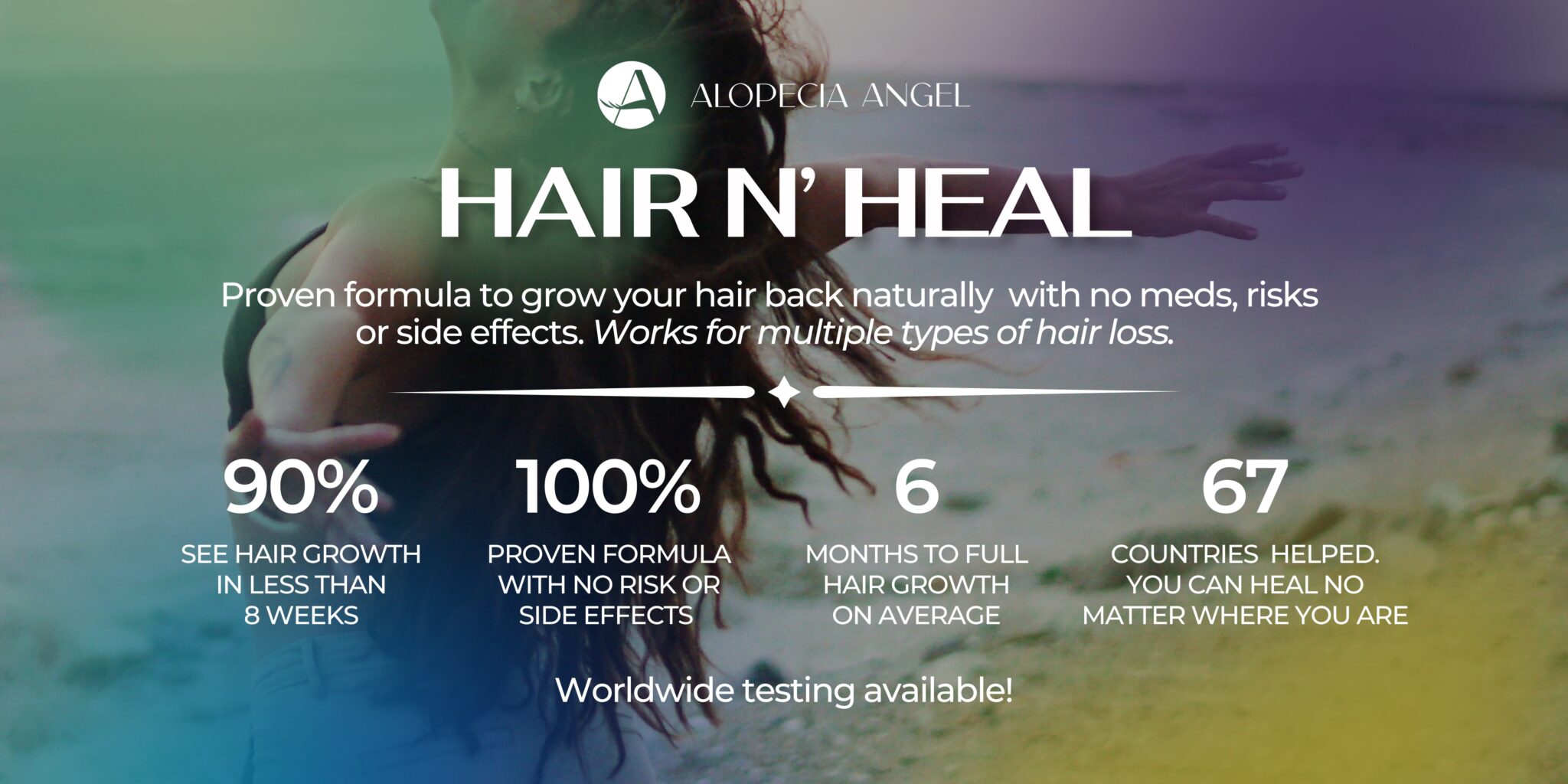
In this episode, we dive into the often-overlooked topic of thinning hair — what causes it, what makes it worse, and most importantly, what you can actually do about it. From the impact of hair products and chemical processing to the role of diet, lifestyle, and personalized care, we break down the real reasons behind thinning hair and how the Hair N’ Heal program can help you achieve thicker, fuller hair — no matter your age or hair type.
–
If you’d like to take the next step in your hair journey, Johanna is offering a free Hair N’ Heal Program consultation. This is your chance to ask questions, explore the program, and see if it’s the right fit for you. Spots are limited, so schedule your complimentary call here.
Check out our Free Downloads to learn the truth about Alopecia
Enroll in our Free Training Heal and Reverse Hair Loss Naturally in 6 Steps — discover how to restore balance naturally and support healthy hair growth
Connect with Johanna for a one-on-one session and receive personalized guidance on your healing journey. Schedule your consultation here.
–
HELP IS WITHIN YOUR REACH!
Alopecia Angel is dedicated to those seeking a holistic, natural, and safe approach to healing Alopecia from the inside out! The main force behind Alopecia Angel is a deep desire to help individuals achieve what I achieved with a natural treatment option, a well-rounded approach to health, wellness, and reversing Alopecia naturally without antibiotics, pharmaceuticals, cortisone shots to the head, or embarrassing creams.
After seeing results with my multi-tiered natural Alopecia treatment, targeting mind, body, nutrition, environment, and other elements, I decided I wanted to share my findings and let others know that a natural, safe, and holistic method does in fact exist to regrow hair from alopecia.
–
Hi everybody. Welcome back to the Alopecia Angel podcast. Today we are talking about thinning hair, and I know this is a big topic because a lot of people out there have thin hair and you’re probably wondering, what can I do with my thin hair? Can I help it? Can I regrow more hair? What can I do about my thinning hair?
So you see me here. With lots of hair, right? Pretty thick. Yes. Some grays, yes, potentially a little bit of different colors and contrast, but I have thin hair. I’ve always had thin hair, and you’re probably not believing me, but I’m telling you, I have thin hair. I’ve always had it. But what I can tell you is that you can always have more of it—more. Thin hair so thin, so thick that your ponytail can be really thick.
So if you’re looking for a thicker pony, if you’re looking for more hair, the Hair N’ Heal program is for you. And it’s for you even if you don’t necessarily have hair loss. One thing that’s always brought my own situation to heart in all of this is that before my actual alopecia areata bout with that in my thirties, I always had thin hair. It could always be thicker like it is now, more abundant, just voluminous and really thick and beautiful. But it’s still a lot, but it’s still thin. But when thin hair thins out, this is actually really scary.
So this is actually where people with coarse hair, with thicker hair in general, have an advantage over people with thin hair, because if you have thin hair to begin with, your main option, your main focus should be to increase the amount of the thinning hair. Because what’s gonna happen is that this is why maybe your scalp starts to show, this is why maybe the sides start to show, this is how your ponytail becomes really thin. I don’t wear ponytails. I wear claw clips, but even in the claw clip, I can tell when my hair is on the thinner side versus a more voluminous, thicker side.
And so there are ways to counteract these too. There are ways to help improve, and so the thing is this too requires an evaluation. There is no product here. There are no gimmicks. There is no shampoo I’m going to recommend or some sort of serum or multivitamin. This isn’t it. We need to look at the whole person because again, as I look back at my own hair loss situation before alopecia areata, I had times in my twenties where my hair was really thin, straggly thin.
And it could have been a couple reasons. Maybe over processing, right? Maybe it could have been maybe some of those hair products that do cause hair loss. So for example, I have a free PDF on my website that tells you exactly all the hair products that cause hair loss either directly or indirectly or that they’ve been in lawsuits for. And so this is also something to understand because probably many times you look underneath the cabinet there in the bathroom and you don’t realize that a lot of these products do cause not just hair loss, but cancer and a bunch of other things.
And so this was one of the shocking truths that I had to go through when I found out my favorite mousse of almost 15, 20 years was discontinued because they found out it caused cancer. It’s one of those things that we don’t know until years, even decades later, and a lot of times things are hidden. Things are hidden. They’re settled out of court so that none of this information that consumers need to know is going to be known about or heard about.
And so that’s the situation that we’re in. So thinning hair, yes, you can help it. There are different types of tips and tricks that I’d like to help you now with and share with. So for example, with thinning hair, I like to say that it’s a little bit more on the delicate side. My hair in particular because it is thin, because it’s curls and because I do highlight, it already gives it a disadvantage, meaning there’s more processing. So the more processing you do, the more you’re antagonizing it. So if you can process less, I know this is hard with some people who don’t want to embrace grays. I hear you. I don’t wanna embrace ’em either. But at the same time, I’m also mindful of how often I process. Whereas before, when I didn’t have grays, I would process all the time.
And so this is also where you can see breakage. So for example, I’ve had stylists sometimes where they’re fresh out of cosmetology school and they don’t understand that when you’re doing the highlight, you should just do the foils up to where you’re trying to cover, not all the way down the line. And so when you continue to put bleach essentially on top of the same hair every time, you’re losing integrity, which means at some point it starts to break. And so this is very common with people who color their hair, and it also thins it out because maybe you won’t see it—that breakage—and sometimes the clumps. It’s not necessarily coming from the scalp, it’s coming from the mid part.
In my case with the highlights, you’re doing ’em from the root, and you should only do ’em about an inch in or half an inch, or however that part line is. But then if you keep on coloring all the way down with that same bleach every time you have a highlighting session, then that breakage is more possible. Another way for you to have more breakage is to not get enough trims. And I say this because you need to trim your hair if you want long hair growth.
My goal right now is to have hair all the way down to my waist or mid-back. That takes time, especially when you have curly hair. I saw this lady in the gym and she had amazing, beautiful hair. She told me it took her seven years to grow it all the way down to her glutes. So I understand, growing all the way down will take time, but that’s the goal I have for myself at the moment.
Sometimes I trim my hair at home and I don’t trim with a stylist because really the hair cutter essentially shapes my hair. She just shapes it to make sure that the curls are doing what they need to do instead of me looking like a poodle. For those of you who have straight hair, if you can’t give yourself a few little trims here and there, then get your hair cut, but then maybe expand instead of every two months, maybe expand every four months. And then what you can also do is look in really bright light to see if you have any split ends, and start cutting those ever so slightly with professional scissors.
Now if I have any flyaways, then I just start snip, snip, snipping and seeing what needs to be done, because sometimes hair can grow more in some areas and in other areas less. I’ve noticed throughout the years too, that sometimes the hair in the back grows a lot faster than the hair upfront. Especially if at some point I had bangs, which I did, or cut it short. For it to catch up, it takes a little bit of time. But this too also needs small minute trims. And so as you keep trimming, then your hair will want to grow longer.
If you see that thinning or breakage, then you need to pause and see what’s happening. Is it my diet? Lifestyle? Is it the medications that I’m taking? I have a free PDF on my website where you can see all the medications that have a direct link to hair loss. Is it something else? Maybe a blind spot, or is it that I’ve colored or highlighted too much?
Personally, I like somebody with at least 15 years of experience because somebody with 10 years or less doesn’t know all the nuances of curly hair. I have thin hair and it gives you results quickly; for example, if you put on bleach, it highlights in less time. This is also some of the mistakes that new stylists have done to me while living abroad. It takes a couple sessions for them to understand your hair texture and sensitivity to your scalp.
But we can control the breakage. We can promote thicker hair and more hair growth; this is the key. Hair growth is available to you anytime, just like the gym. You just need to take the steps in order to see that thicker hair. During my time with alopecia, I lost over 50% of my hair. I had the bald spots and patches that all connected, and I was losing eyelashes and eyebrows as well. It’s all scary and unsettling. But as someone with thin hair, you notice the thinning real quick. Especially when it’s wet, you start to look like a wet rat.
My key first is that you need to understand and believe that you can have more hair. Yes, it’ll always be thin, but you can have more of it. You can have thicker hair where it’s literally really thick. I’m in my mid-forties; anyone can do this, whether you’re 85, 45, or five. It’s really about personalizing the diet and lifestyle. No one pill, no one shampoo is gonna get you to those results.
So those are my tips for thinning hair: get your trims, make sure you’re working with people who have good experience, and really be mindful of how much you color and process. Bleach is a toxin and a chemical. Sometimes you process so much and your hair just can’t withstand it. One lady who contacted me lost 60 to 75% of her hair just as she was washing out dye. Chemical interactions between store-bought and professional salon dyes can do lots of harm.
Thin hair can always improve. Don’t think it can’t. Even if you were born with it like me, you can always improve it. You can always have more of it. This is where the Hair N’ Heal program comes in. We evaluate you and look for blind spots or areas that are hindering you so that you can have high performance hair growth in less than eight weeks.
I invite you to look at the Alopecia Angel website to see our free training and free PDFs. I’m happy to hear from you and help you get on the path to high performance hair growth today. Thank you so much. Bye-bye.