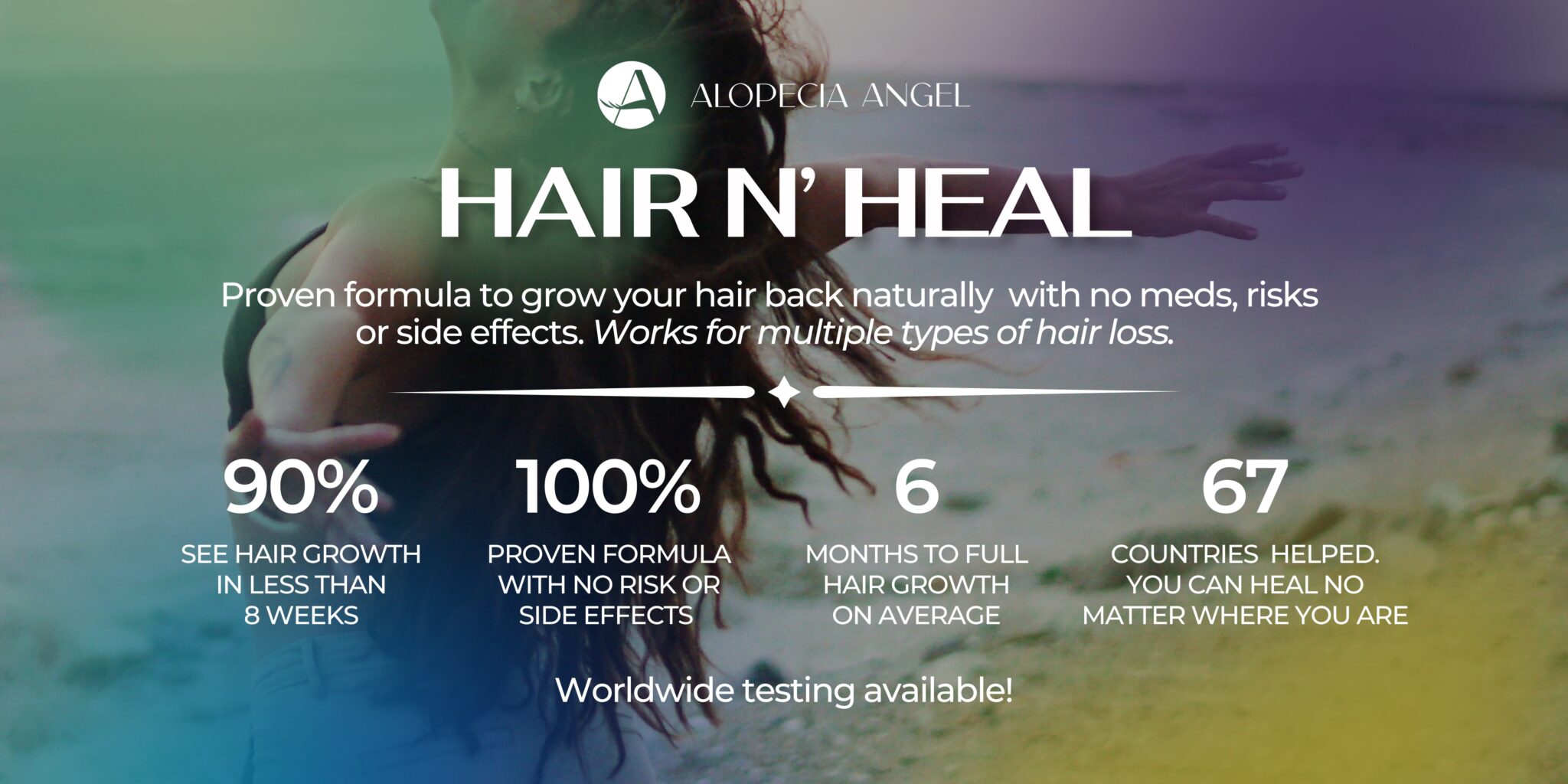
In this episode you’ll discover inspiring testimonials from clients experiencing remarkable hair growth from the Hair N’ Heal program. We’ll also delve into an insightful interview with Karie Johnson, a certified nutrition and fitness coach + integrative health practitioner. Karie is a part of Life Network, a social wellness platform designed to transform your health.
–
Get on the Hair N’ Heal Waitlist
Check out our Free Downloads to learn the truth about Alopecia
Enroll in our Free Training Thyroid & Hormone Masterclass — discover how to restore balance naturally and support healthy hair growth
Ready to take the next step? Talk with Johanna one-on-one and get personalized guidance on your healing journey. Schedule your consultation here.
–
HELP IS WITHIN YOUR REACH!
Alopecia Angel is dedicated to those seeking a holistic, natural, and safe approach to healing Alopecia from the inside out! The main force behind Alopecia Angel is a deep desire to help individuals achieve what I achieved with a natural treatment option, a well-rounded approach to health, wellness, and reversing Alopecia naturally without antibiotics, pharmaceuticals, cortisone shots to the head, or embarrassing creams.
After seeing results with my multi-tiered natural Alopecia treatment, targeting mind, body, nutrition, environment, and other elements, I decided I wanted to share my findings and let others know that a natural, safe, and holistic method does in fact exist to regrow hair from alopecia.
TRANSCRIPT
Johanna: Hello everybody and welcome back to the Alopecia Angel podcast. I am Johanna Dahlman your host. Today I wanted to showcase Karie and her Life Network, but at the same time, before we get into Karie and her story of gut health and resilience and also fitness and so much more that we get into. I wanted to showcase another 2 clients who are seeing progress and who are seeing remarkable hair growth and health benefits inside the Hair N’ Heal program.
So you will hear their testimonials and then we’ll move into Karie’s interview with me. Karie Johnson is a certified nutrition and fitness coach, integrative health practitioner, host of the Life Lounge Podcast and Life Network community director. With over 15 years in the health and wellness industry, she has owned and operated two successful Barre3 studios, coached thousands and worked alongside experts like Ben Greenfield to bring cutting edge wellness solutions to a thriving community. Her own journey, overcoming gut health challenges through biohacking and many other, fuels her passion for helping others unlock their full potential. As the host of the Life Lounge, Karie is dedicated to fostering transformation through mind, body, spirit, and community, creating spaces where people feel supported, encouraged, and empowered.
So I can’t wait for you to hear that episode with Karie Johnson, who is also a dear friend of mine, and then also these next two testimonials. So here we go. Thank you.
Christy: The last dermatologist, she thinks that it’s intelligent blue, and my mind was stuck. It was on this repeat of: I’m gonna lose all my hair, people are gonna notice, what am I gonna do? I’m gonna have to get a wig. Just this constant replay, even though I’ve been on a lot of antibiotics my whole life, because the sinusitis bronchitis. I always tried the natural.
First, but the dermatologist I had before said: I’m gonna put you on Minoxidil, finasteride. I picked up the prescription, but I was like: I don’t want this.
Johanna: What would you say to anyone who’s on the fence?
Christy: Do it because you are worth it. Getting your life back is worth it.
Dominique: A little bit like on my head. So there’s hair
Johanna: growth on your hair? Yeah, a little.
That’s fantastic. How are you enjoying the program?
Dominique: Oh, I love it. I love it. Like I love getting healthy. Yeah. I love getting healthy and seeing the difference and yeah. But I love it.
Johanna: All right, Karie thank you so much for joining me here at the Alopecia Angel Podcast: Awaken to Hair Growth. Thank you so much for being here.
Karie: Thank you for having me, Johanna. I had you on our podcast before and I am just so grateful to come on yours now. We live very close to each other in Boise, Idaho, and we had a mutual friend connect us and I’m just grateful to be a part of your podcast today. Thank you for having me.
Johanna: Same. So tell us, Karie, a little bit about your background, your personal health journey, and what Life Network is.
Karie: Oh, I love that. Thank you so much. So yeah, I currently work for Life Network as a community director and host of the Life Lounge podcast, which is where Johanna was on a podcast with us, which is so fun. And then, so with Life Network, I am a part of an amazing group of individuals. It. Started with Ben Greenfield, which is one of the top biohackers in the world, and we bring in the best of the best premium curated content from experts like Johanna. And so people do not have to sift through the noise of everything that’s out there and really cut through all the clutter, get right to the best of the best people who can help them in whatever, issue they might be having, whether it is hair loss or anything from, menopause, perimenopause to gut health, to, just looking for a functional medicine doctor.
So we have, you name it, we have an incredible names behind our brand, Gary Brecka and Dr. Amy Hornaman, thyroid fixer, you name it, you know the list goes on. It’s an incredible platform. It has an app as well, which is completely free. If you wanna uplevel and take off ads and things like that and get access to our, our coaching as well, then the app is $15 a month. But other than that, it is great content. We also are doing a new feature, which is soon, I don’t know if I told you this about the Johanna, maybe I did, but it’s called Life Places. Life Places is gonna be where you can really connect people locally who are, like-minded, whether biohacking, longevity, looking to swap out some of their nasty products for their family, things like that.
So we are currently working on that. That should be live pretty soon. And then we’re doing a whole entire rebrand too, so anybody who is in the tech industry or has built apps before websites, you know, how much work it is. But we’re excited about that feature. And then we have coaching as well. So if you’ve ever followed Ben Greenfield, he is the ultimate biohacker and fitness coach. And I’m also one of the coaches for them
too. So for my background in fitness. I owned Barre3 exercise studios in Arizona for 10 years, and I have also coached additional women on the side, just on my own. In terms of gut health, i’m an integrative health practitioner, and fitness coaching. So I wear a lot of hats in a day, as does Johanna. But, yeah, I’m a native of Arizona and new to Boise, Idaho, as of almost a year. And I’m 45 and in perimenopausal, that’s another thing too.
Johanna: So tell me, how is it that you got into health and wellness to begin with?
Karie: Yeah, great question. So I was grateful to be raised in a family that really valued exercise and healthy quote unquote eating. Back then, being raised in, 80s, 90s it was more like the fat free movement. But, my parents did for the most part, like healthy dinners on the table from the knowledge that they were given, and they were always active. So I’m, very blessed to from a family that was active. So that was instilled from me young, my dad and I, he was a pilot and whenever he would come home, we would go hiking up in the mountains in Arizona. I, those like my fondest memories, I played tennis all throughout my childhood, and you know it through high school and absolutely loved it. It was into yoga, in college, you name it, I’ve probably tried every single fad or form of, fitness.
And then what happened with Barre3, which I did for about 10 years, from 2013 until about 2022. And it was an incredible season of my life and I’m very grateful to have ran those studios. I taught, I don’t even know how many fitness classes probably. Into 3000+ fitness classes and be like, I could be more, but that’s just, the teaching part, and then taking classes too. So I loved Barre3 because it was a, a. I pulled in not only like my love of yoga, it was a great focus on posture, but it pulled in Pilates as well. And then functional movement, functional fitness. And I felt like that, is so important in today’s day and age, like being able to, reach up over your head to put your suitcase up, in the overhead bend to bend over and. Not hurt your back and, really work on that core strength.
So I loved Barre3 for that. And then just moving the body in every single plane of direction that our bodies are supposed to move. It’s such a gift to be able to move our bodies. Sometimes we think it’s, a punishment to work out, but once that mindset kind of flips, you realize it is such, such an incredible blessing to be able to move our body. I did that for a long time and then now in my 40s I am more into weightlifting, which is great. So I’m adding in heavier weights just because a lot of the research that’s out there for women specifically, it is very important to build muscle in hopes to like really offset sarcopenia bone loss and prevent you know what happens as we age is we’re just gonna completely lose all of that, the bone density, and that’s how, if we get injured or if we fall, then things just go downhill really fast when we get older. So my goal is to just, live as long as possible, but not just adding years to my life, but life to my year.
So I want to be strong and healthy as much as I can. It’s not a punishment for me, it’s more of just a: I’m doing this for my grandkids so I can, run up and down to the beach with them one day and. Not have to sit on the sidelines and just watch them from afar. So I really want to view fitness and I help, women that I coach view fitness as a blessing
and find something that works for you. It doesn’t have to be a punishment, you don’t have to do it for hours and hours, but just moving your body every single day. And if that’s just starting with walking 10 minutes a day, doing that. And then little by little you’ll add on different things, because you’ll notice like what feels good in your body. Long story short there.
Johanna: I love it. I love it. I came from a family that was just the opposite. They were not necessarily workout people or nutritional. I guess at the time for what it was, they were healthy-ish, but not necessarily super healthy. Or as healthy as I would, consider today in today’s standards or your standards today. But I did get into yoga and pilates early on. I remember it had just come out. Living in California, in Orange County. Yeah. And I started with some private sessions and then I went into the group sessions and that actually gave me a good basis as to understanding like how to engage every muscle. And then from there, doing Pilates straight from 23 on, I became certified later on in both pilates and yoga. Pilates gave me that strong core. What took it away was being pregnant.
Karie: I know.
Johanna: It just annihilated my core and I didn’t know how to, it was like another uphill battle trying to get there. And I’m still not there as to how I was before. Being pregnant, during COVID, not being able to go to any gyms or having everything closed and only doing at home things. Which for the most part it was prenatal yoga, walking and bicycling. And that was it. That was the most that I could do while pregnant during COVID. It takes a lot of discipline, especially postpartum. So what would you say? You have that experience, right? Even here recently?
Karie: I do.
Johanna: What would you say is like beyond the core or beyond, I guess the norm of how we should view working out and fitness postpartum as a parent, as a mom, where your body changes on so many different levels. How would you approach fitness again, from this lens of being a new mom or a mom again, or a mom that didn’t really plan on being a mom, but now you’re a mom again?
Karie: That, that is a great question. And when I was teaching all of my bar three classes, I did that all the way up until my 38 weeks pregnant with my last child. Then I also taught, hundreds and hundreds of women throughout their pregnancies as well. And pre-natal exercises as well as postnatal exercises need to look very similar, and it’s not crunches as people think that it’s, that you need to be doing crunches to get back your core. It is not that at all. Like the more just gentle movement and really even strengthening your back body, the whole posture the whole entire chain. It’s not just about that six pack abs, because number #1 you’re not gonna get that when you’re pregnant.
That should not be your focus or you’re actually gonna cause more damage than good. And you will actually get that diastasis recti where the muscles separate and you could literally put depending on how big your diocese recite, you can put so many certain fingers inside that area and it’s not good. You literally get your muscles completely separated and they needed to right, in order to, for the body to expand and the baby to grow. But then afterwards, what women do think and they’re actually causing more harm, is they’re like: Okay, the baby’s out now. I, i’m just gonna go right back to crunches and all of these things, and this is the worst thing that you could do. So please don’t do that.
So really focusing on, it’s still gonna mimic the pre and the post is gonna be very similar and treating the body. they call it the what, the fourth trimester, right? So it is such a thing and people do not give that your body enough time, mentally, physically, all those hormones that are coming through your body and just like releasing and I’m sure you’ve talked to all of your clients your many clients, their hair sheds, right? Because of all those extra hormones. They’re just being processed through the body. So as much as somebody can, just take it easy and don’t be so hard on yourself because you will actually cause more harm than good. And then, focus on walking, focus on, stretching deep breaths.
You could still do some core exercises and there’s many videos out there for specific, pre-natal postnatal exercises. But the more that you can just, get outside, get some vitamin D, walk, take it pretty down to the basics, strip it down. You can, if you were doing strength training before prenatal before even you got pregnant, then you can continue on.
Always give talk to your doctor because sometimes they’ll say 6 weeks postpartum don’t add anything on, 8 weeks postpartum. It just depends on your pregnancy and how you are recovering too. Don’t push it. I would say, just err on the side of caution as much as possible. If you were doing weights before, you can continue that on after you’ve gotten clearance. But I think again, just your muscles are different and try not to fight that change that’s happening. ’cause it’s a beautiful change and we’re like: Ah, I wanna look exactly like it was, a year ago or whatever. And it’s hard for us to see that. So as much as you can just lean into the season and not fight it.
Johanna: What I do love too about Pilates in particular is that what really. Had my eyes widen was when I saw women, and this was when I was back in my 20s and barely knew beginning this, is that I saw ladies in their 70s, ladies in their 60s and they were holding planks longer than I was. And so that they were doing this. And I was like: Wow, these ladies, they’re so strong, they’re doing this for like so much, minutes or seconds longer than me. And I’m here like a third of their age, and yet being able to crumble just like this of my own. And so when I started seeing how pilates itself is so good for longevity.
What exercises outside of Pilates would you recommend from now till forever? So which ones would you actually recommend? Because what I’ve. Understood is that HIIT for
example, is not necessarily good for menopause. It’s not necessarily good for all these fluctuations in hormones. It’s not necessarily good for longevity. So which ones would you, let’s say, open us up to and say this would be now till at any point in your life.
Karie: Great question. So there is so much out there, right? And that’s what’s so confusing, especially for women. And then a lot of times is the workouts are pitched to us from a man and they don’t understand the woman’s body and the cycles. And from whenever you get your period all the way up to perimenopause and then perimenopause to menopause and like our bodies do change. I do really lean into like pay attention to your body during your cycle. So for me right now, after a lot of research and working with Ben and his whole entire coaching team, and trying every single thing under the sun and the research backs it. So strength training 3 times a week, and if you can total body workout, like it’s total body and it could be 30 minutes, 45, an hour, whatever you have.
And if you need to break that up and do a couple 10 minute sessions throughout the day, but at a minimum 3 minutes strength. And then from there, if you can, HIIT actually is good to add, but it just depends on your cycle. So right now I’m in luteal, so I actually am not doing HIIT because the added stress. Like I usually don’t sleep well. My HRV tanks, my resting heart rate tanks. So I actually, I track everything through my aura, but then also at the same time, so not only looking at the stats, but just paying attention to how my body’s feeling and what it needs.
If I’m not doing two HIIT sessions in a week, just depending on how I’m feeling, what my body needs, then I’ll do rebounder bouncing up and down on the trampoline, getting that lymphatic drainage, so that’s what I did today. 20 minutes of rebounder. I’ll take my dog on a walk later on this evening for probably at least 20 minutes to 30 minutes, just depends. So getting outside, getting a walk if you can every single day. It doesn’t have to be that long if you can’t do it that long, but I would say that is your baseline is walking. Then add on strength training next after that, 3 days a week, like I said, of 30, 45 minutes. And then after that 2 HIIT sessions, just depending on how you’re doing. And then after that, it’s just adding on yoga or pilates, once or twice a week.
But, so again, walking is your baseline. From there, add on strength 3 days a week. From there, HIIT if you are feeling like your body can handle it that week, depending on your cycle. So pay attention to that. If you’re not gonna do HIIT, then maybe do your hiking. Do your rebounder go outside for your longer walks, and then one or two sessions, maybe yoga, maybe pilates. It doesn’t have to be both, but some kind of like mobility, stretching, things like that.
Johanna: I love it. I love it. So when winter comes, because you and I we dread the winter.
Karie: Oh yeah, I do. I am a, I call myself a lizard. Like I really love the heat. I, it’s probably from being born in Arizona, but who knows?
Johanna: Same. I love it. So when winter comes and, we are stuck inside. We don’t wanna leave. Personally, I don’t wanna even leave the house. Let’s say a gym membership or getting to the gym is not possible because of maybe snow or just cold weather. Or what have you, or maybe just dangerous conditions. What would you recommend when you are inbound? When the walking outside is still not a situation. I don’t know if you, if people walk their dogs when it’s snowing. I’m not sure if that’s a thing or not. I don’t have a dog, I don’t know.
Karie: Yeah, so we have a dog and like I said, we’ve been in Idaho for just about a year now and we made a commitment to ourself that we are gonna walk our son to school, rain. Snow, sleet, hail, like every single day. We didn’t miss a day this whole last year that she was, he was in school. So with our dog, with the snow, with ice, it was, very challenging. We didn’t miss a day. But if you don’t wanna go outside during some of those, like crazy times if you can, because it’s really good for your circadian rhythm for sleep. And that’s super important for women. If you can even just get outside first thing in the morning when not, depending on when you wake up, but when the sun is rising, it could be 5 minutes. It might be cold, but 5 minutes. Get outside, get some fresh air and let your eyes see the sunrise.
And then at the end of the day, the sunset time, get outside again for 5 more minutes. So that’s your bare minimum. If you live in a cold area and you don’t wanna go outside, like just try it like 5 minutes and 5 minutes.
It’s really gonna help you sleep better, I promise. And then from there, if you still don’t wanna go outside for like your walk or drive to the gym. If you’re able to get either a treadmill or a rebounder. I love my rebounder and then I do have my indoor treadmill for when I know I’m not gonna get longer walks in, then I’ll do that.
Johanna: So let me ask you, how are you preparing for menopause?
Karie: Oh, that’s a great question.
Johanna: I know, right? We’re kinda the same boat, and it’s just like you and I, we speak to so many professionals. We have a lot of experts on our phone. And so it’s just one of those things like, that challenge of getting to that next phase in life, it’s gonna come. I tell my younger clients who are in their 20s and it’s just like: This phase is coming. So this will pertain to you whether or not you wanna get on the rollercoaster.
Karie: Yeah, it’s such a good question, I think, for any woman who has basically had their cycle, that needs to be aware of. When you’re younger, in your teens and even 20s, like menopause seems so far off, right? And you’re like: There’s no way that’s gonna happen to me. And it does happen to every single woman. So just, for me right now, and I actually took a whole entire course on this from Angela Foster, it’s called the
21 Day Hormone Reset. You don’t follow Angela Foster. I highly recommend her podcast. She’s actually an expert inside life network and she’d offered this 21 day hormone reset.
And one thing that I learned the program actually just wrapped up. One thing that I learned is after you go through me menopause, your brain actually gets an upgrade. Did you know that Johanna, like your brain?
Johanna: I didn’t. That’s good to know. All I hear about is dementia because of the lack of estrogen, the lack of progesterone.
Karie: You know how like when we were pregnant, we feel like you have, it’s called pregnancy brain, mom brain. Because a lot of those nutrients that we need are going to the baby, right? And then afterwards you kinda get some of those brain cells back. You come back to your, normal brain level. But then through me menopause, you feel like it’s gonna be similar. You get that same like brain fog, right? And you’re like: I was gonna say this, I don’t remember what I was gonna say. And that happens to me already, like in perimenopause too, like perimenopause, menopause your body’s going through these different changes and you will get brain fog.
So number #1 is to know, not to fear menopause, right? Because I want you to think of it as like it is a brain upgrade and we’re gonna go through this cycle in order to get to the other side. And then once we get to the other side, like just the beauty of that season and approaching that as just like a different life season and not looking, comparing yourself to who you were in your 20s or 30s or 40s. ‘ Cause you’re this whole other beautiful woman and you’ve it’s a butterfly coming outta their chrysalis. It’s a beautiful season. So I would say first and foremost, it’s about mindset and just not being afraid of it. And then second, yes, dementia, Alzheimer’s, I think for women to be very aware of. Number #1 if it’s in their history. And doing what you can do to counteract that as much as possible.
One thing I also learned from one of our experts, I have, an incredible privilege to be able to host these incredible people through Life lounge. And so I just hosted Dr. Eniko Loud, she’s a functional, holistic, integrative dentist, and she was talking to me about flossing, and how flossing prevents dementia and Alzheimer’s. Isn’t that crazy? And she was talking about it because it’s, the inflammation, and the buildup. And so that’s, I am not a doctor so I can’t speak as eloquent as she did and like how that connection happens. But it’s okay, I’m flossing more. So I am like, make sure you’re flossing because that’s gonna help.
And then make sure you’re moving every single day. Get outside, like we talked about as much as you can, depending on the weather. Just moving your body and if it’s. If it’s just a walk that day, don’t beat yourself up, but try to get some sort of movement. If it’s, again, maybe it’s cold outside and maybe you don’t wanna purchase a whole entire, weight system to have at your house. Pushups, squats, sit-ups, burpees, if you wanna be extra crazy, there is set a timer and do 10 minute snack breaks if you can throughout your day just to break up sitting. Sitting is the new smoking and it’s horrible for our posture and we’re counteracting everything that we’re doing in our daily lives. Focusing on posture, get away from your screen.
Go outside, do a 10 minute snack break. I like to call it a snack break, just because it’s like: Yeah you can go have a snack, but you also have a, it’s a snack break for your body. 10 minutes. It doesn’t even have to be 10, it could be five and it’s gonna do wonder. That is huge. In prevention, all dementia, Alzheimer’s, obviously, you can get into the whole supplements and everything. Fish oil, for inflammation, CoQ10 is really good for that as well. I highly recommend anything by Thorn is one of my favorite brands because they are triple, tested, and NSF certification, which is like the best of the best that you could get. So you gotta be careful with your supplements you’re getting. Don’t just get any random supplement on Amazon. And then nutrition obviously, right? So feeding your brain. Trying to get as many, colorful vegetables that you can and fruits throughout the day as much as you can. Protein is huge for women. As I always like to say about a pound per body weight. So if you’re a hundred pounds, a hundred grams of protein a day, and then break that up into 3 meals a day, four meals a day, and try to hit that goal.
Johanna: There you go. Is there any health challenges that you’ve had either growing up or that you’ve seen growing up and have they been rectified? Through a very maybe surprising or astonishing way that you’d like to share?
Karie: Yeah, definitely. I will definitely share my own gut health, journey because it seems like every single person experiences some form of gut issues these days due to many different factors that we, growing up in the 80s, 90s like we were given antibiotics, we were, not really told to look at why we’re getting sick, just cover it up with some medicine or prescription and just be on your way. But the damage that antibiotics ended up doing to my gut, it’s hard to say if it, that was exactly what spurred it on, but I ended up going through probably, and I still, I call my, I say like I have a princess gut because it, it can get inflamed from time to time.
But thankfully I know how to help it out nowadays. There was probably a period of 3-4 years where I went through. Candida, H. pylori, SIBO, gastroparesis, you name it. I pretty much had any type of gut issue that was out there, and thankfully I was able to cure myself with all of those things. Sometimes I actually did try to go the traditional route and do medication, and I did do medication for a few of those. Then I was like: I don’t wanna be on this for the rest of my life. I’m gonna figure out another way. And the kind of same thing with how you talk to your patients, Johanna with their hair too. It’s like they don’t need to be on this medication with all these side effects. Because I was like, I know better than that. I don’t wanna do damage to myself later on, like 20 years from now because I’m taking this medication all the time to help my gut.
I healed my gut thankfully through just a lot of different natural protocols and cleanses. So I usually take a probiotic, fish oil is still really good too. Glutamine, glutathione. There’s so many good things that we can do. And just like prebiotics, probiotics yeah. And then try not to have the ultra processed foods as much as you can, because those are the ones that do a lot of damage too, just like the nasty junk. So like processed foods, like you process a food, you can process an apple if you’re cutting it up and
turning an applesauce, but that’s one ingredient, maybe two or three. If you’re gonna add some like salt or cinnamon in it, that’s a processed food. But an ultra processed food, that’s when there’s like all those extra additives and fillers. And if you look at a label and there’s more than five ingredients that you cannot pronounce, throw it away.
Johanna: Yeah, I have a I have very strict rules and guidelines in the house. I’m sure as you do too. Because, especially coming back to the us when you go to Europe and you live there, when you live in Japan, you see how the ultra processed foods don’t exist.
Karie: Thankfully I think the tide is slowly turning in America and, hopefully other countries are still not adopting America’s, eating in things that we do. But yeah, thankfully I think things are starting to turn around and people are more and more aware of the damage it does to our body. So crazy.
Johanna: Thank you for sharing your own story. I always love to hear how people go through or get into health and wellness because everyone has their own story of why they’re so passionate about it. It’s not just outta nowhere, it’s outta something.
Karie: You make your pain, your purpose, right? And that’s for most people. That’s where their most, their passion lies because they wanna help the person that they once were.
Johanna: Yeah, absolutely. Any other tidbits or nuggets of wisdom that you’d love to share with our audience?
Karie: Oh man. I would also say sleep. So sleep is so important. And that can affect so many different things. And it’s something that also that feels like the older that I’m getting, like the more importance that I put on it. I always said I was a good sleeper, but then, I would stay up super late and then get up super early to fit in my workout. And as much as you can, like trying to. Like we talked about before, the circadian rhythm. So getting in alignment with how your body naturally will produce melatonin and it’ll be ready to fall asleep and try not to have the blue light as much as you can throughout the night because that’s gonna, artificially stimulate your eyes to say awake.
And so limit that as much as you can. Dim your lights at nighttime so your body can really start to wind down and then if you can, and not everybody can do this, but let your body just wake up naturally and the amount of sleep that it needs to get. And for me, I used to push so hard of I’m not gonna be able to get my workout in, or if I don’t get up, 4:30, 4:45, 5:00. Like I have to get up super early in order to get my workout in. But to be honest, you’ll actually do yourself more harm if you are forcing yourself to get less sleep in order to get your workout and instead allowing yourself to sleep because that is where your brain recovers and your body recovers, and that truly is they talk about beauty sleep. The importance of sleep. Don’t underestimate it. Don’t wait, it’s not like sleep when you’re dead. Like you will be dead sooner if you do not sleep.
Johanna: I agree with that, that, that happened to me. Where you just keep going, you put sleep on the back burner. And lo and behold, it comes back to bite you. In regards to sleep with menopause. This is something that, because of our hormones that we see less and less of. But beyond that, I wanted to touch upon something that you said here recently about how do you help or en coach your clients to get everything in? When they already have a hectic schedule and you don’t want them to sacrifice the sleep? What I find is that, for example, having lived in so many different countries, you adjust and adapt to the pace of life to everywhere else.
So for example, in the Netherlands, on a Sunday, nothing would be open until 1:00 PM. Nothing. You couldn’t go to the supermarket, you couldn’t go to the movies. Yeah. You couldn’t go to anywhere. Everything was closed till 1:00 PM, and so you are forced to take a break. You’re forced to go on a walk, you’re forced to stay home, you’re forced to do, you know what you need to do. So that productivity type A personality didn’t function necessarily so well in the beginning in Europe because you’re like: What’s going on? It’s Sunday, everything needs to be open and nothing was open. Certain days and times, especially on their own holidays, which as Europeans have many more holidays than Americans, you’re like: Oh my god, these people never work.
Karie: It seems like it. I lived in Spain for a bit too, and I remember like the siestas are a real thing and the places not, opening until a lot later. America is a great place to live and I know you definitely can testify to that since you’ve lived so many places. But yes, like it is that like hard charging type A, like you have to get it all done in this timeframe and if not, then you’re just gonna skip it on your sleep and that’s okay, but it’s actually really not. We need to take a page from our European friends and, I would say for the person who is trying to get every single thing in, because I am that person all the time.
So doing a time audit if you can, as much as possible, like really if you can like track for a whole week if longer or, just a few days just to see where your time sucks. Are you staying up too late watching shows? Are you doom scrolling on social media like you’re sacrificing on sleep? Usually like a couple hours at least, at least a couple hours. Like it’s scary when you pull up your screen report like I was on my electronics that much, that’s insane. I know it’s hard for some people because they’re like, no, don’t take away my show, or, that’s the only way I have time to relax. Give yourself a timeline, give yourself a limit. Just as a parent would put controls their screen time for their teenagers. You have that ability on your phone, put yourself a time limit on it until it becomes more second nature.
And it’s again, like the blue light and it’s going to stimulate the melatonin, or block the melatonin and you’re not gonna be able to sleep and then you will not get up as early as naturally. So as much as you can cut those out so you can go to bed earlier and you’re still getting that full amount of sleep and getting up, you actually do end up getting up earlier because your body is starting to naturally produce that melatonin wake up when it needs to wake up and it’s being fully is refreshed. If you’re able to delegate certain things, whether that’s, instead of going to the grocery store and, spending too much time like shopping around, maybe get your groceries delivered, right? Just little things
that you can delegate or automate just to get a little bit more time back in your day. And thankfully we, thankfully in today’s day and age, we have this ability to get a lot of things done at our fingertips and, move on with the rest of the day.
I like to do gratitude journal every single day, and I focus on like my big three, like what are my top 3 things that I need to get done right away, non-negotiable. I actually do a top 3 for family stuff and then top 3 for business. Making sure those are done and then everything else is icing on the cake. And then, cutting out some of the electronics.
Johanna: I would say too, if I wanted to add onto that list and yeah, share. Would be to say no more often. A lot of times when I was in my 30s, I would over commit and I would say totally me too everything because I had FOMO because I couldn’t, hold those boundaries and I didn’t wanna miss out and I just wanted to be everywhere and I just felt like I could run biologically, from 5:00 AM to 10:00 PM every night without any issues. And there is an issue with that. And I actually find myself saying no more often, making plans, weeks or even a month in advance versus this Thursday or this Friday, it’s never for this week, it’s for 2 weeks at least for a buffer.
Because this way it gives me some time to breathe without having to feel like everything is due now, when really none of it is due. Everything is a choice. and so once we start again using that mindset that everything we have is a choice. Like me grabbing lunch with you is a choice, but yeah, we don’t have to over commit ourselves to so many things and the time and the space to say no when and if necessary. I know that it gets harder with kids, and especially in your case where you have 3 kids, 3 different activities, 3 probably different sports and three different times that they’re in and they need you in a different way. And so you definitely have to show up. Like I just don’t know how people with 5 plus kids do it. These little humans need so much of you.
Karie: Those are built in like boundaries already, right? Because when you are so busy and filled with those, commitments, your children, and their activities, like you have to say no to more things. So you are just automatically given those boundaries. But I was the same way Johanna. So for that person, again prioritize what is like the most important thing to you, like with your family, what’s the most important thing to you for work and then your social life and like really drill down into that, do some journaling and really think through like: Where do I wanna spend my time? If I do have, if I could design my day, what do I want that day to look like?
And then like really put some boundaries around that. Because like you said, it’s if we are like just living at the seat of our pants and like just scheduling on a whim, and we always feel like everything’s on fire and then that creates stress. And then stress is not good. A lot of times as women, like we are holding so much and like we, and then we literally, that’s also causes gut issues too and hair loss potentially. Stress does so much damage and lack of sleep. Like you said, yeah, boundaries, say no, it’s okay. There’s the saying if it’s not a, hell yes, it’s a no.
Johanna: I agree. I agree. Anything else that you’d love to leave our listeners with? Any things or mantras that you live by or that you wanted to share?
Karie: My favorite Bible verse is Psalm 46:10 Be still and know that I am God. So for me, that’s the verse that’s always in the back of my head because I am like that type A, achiever type of personality. During that season of all my gut issues like that verse was just like always in the back of my mind: Be still. So it’s, it’s a reminder myself and to anybody else out there that just needs to that reminder, it’s okay to slow down and push pause, maybe go read a book, maybe go outside and take a walk. It’s okay.
Johanna: I think even with the slowing down part, because we’re both type A. I think that’s probably one of our biggest challenges, but at the same time. It’s also so refreshing once you do give yourself some space, because I don’t know about you, but like when I’m in the shower, I actually have that time of space and even clarity of like new ideas, new thoughts, and new ways to solve a problem come about. And you’re like: Aha, Moment, right in the shower. It always happens in the shower, right? When you’re like, doing something routine maybe. And you just, you give yourself again that meditative space to think and just wander with those thoughts.
Karie: Yeah. Slowing down in the shower on a walk, maybe take out, the podcast for listening.
Johanna: I love that. Thank you so much, Karie, for joining us on the Alopecia Angel podcast. It was such a delight to have you here and for you to share your wisdom, share your network, share Life Network, and share your experiences because I think once we have, and we, once we’re always, engaging with everyone’s experiences, then we can all learn from each other. I think that’s the beauty of connecting, forming friendships and forming, community around health and wellness. Because the more we can do and provide, the more we grow all together as a whole.
Karie: So true. That’s one of our mottos at Life Network is self transformation through community. So yeah, learning from each other because we will go farther. So good, thank you Johanna, for having me. I appreciate it.
Johanna: My pleasure.