Chelsea’s website: https://www.chelsealitsey.com/
.
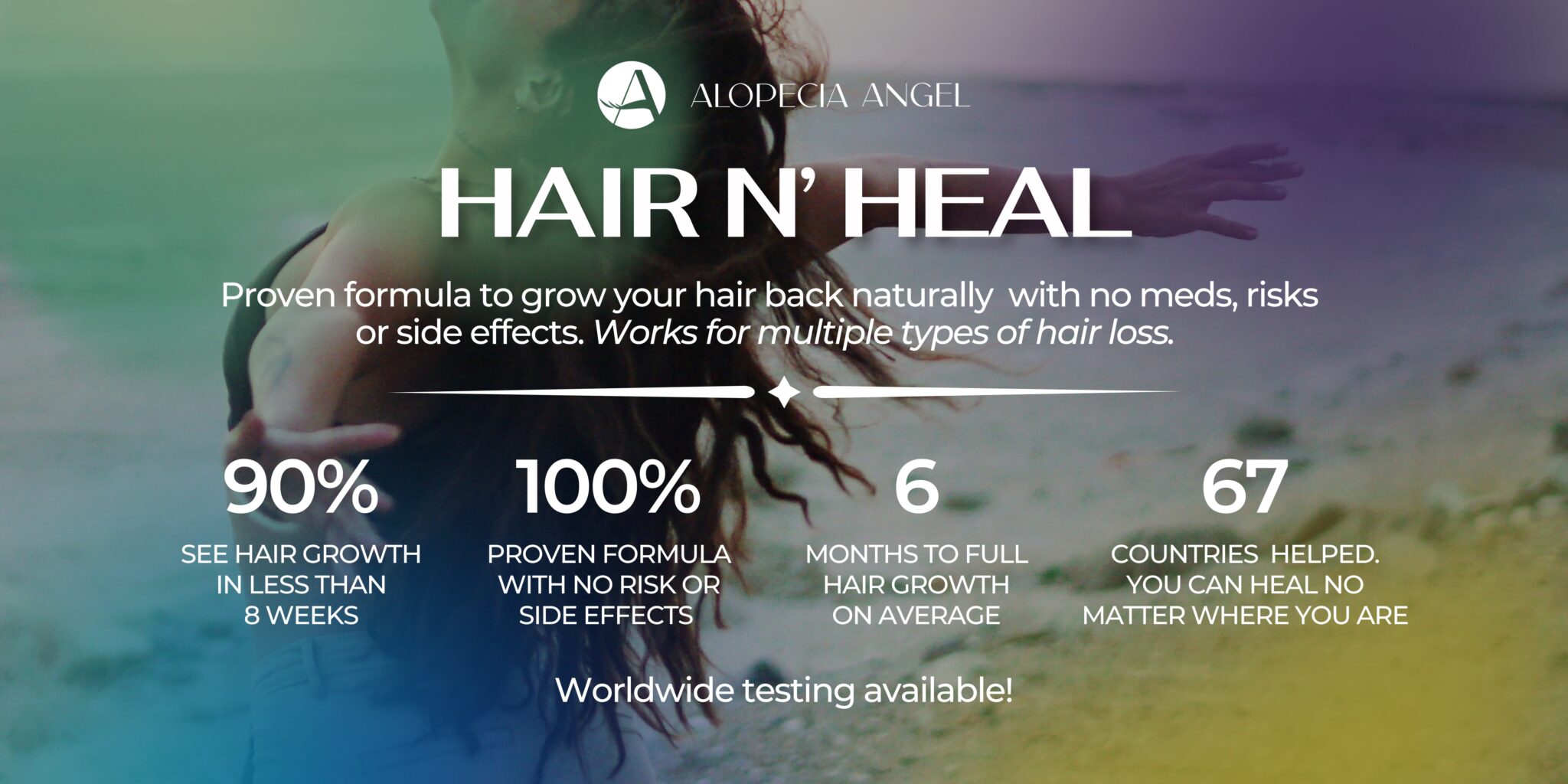
If you’d like to take the next step in your hair journey, Johanna is offering a free Hair N’ Heal Program consultation. This is your chance to ask questions, explore the program, and see if it’s the right fit for you. Spots are limited, so schedule your complimentary call here.
Check out our Free Downloads to learn the truth about Alopecia
Enroll in our Free Training Heal and Reverse Hair Loss Naturally in 6 Steps — discover how to restore balance naturally and support healthy hair growth
Connect with Johanna for a one-on-one session and receive personalized guidance on your healing journey. Schedule your consultation here.
–
HELP IS WITHIN YOUR REACH!
Alopecia Angel is dedicated to those seeking a holistic, natural, and safe approach to healing Alopecia from the inside out! The main force behind Alopecia Angel is a deep desire to help individuals achieve what I achieved with a natural treatment option, a well-rounded approach to health, wellness, and reversing Alopecia naturally without antibiotics, pharmaceuticals, cortisone shots to the head, or embarrassing creams.
After seeing results with my multi-tiered natural Alopecia treatment, targeting mind, body, nutrition, environment, and other elements, I decided I wanted to share my findings and let others know that a natural, safe, and holistic method does in fact exist to regrow hair from alopecia.
–
TRANSCRIPT
Hello everybody and welcome back to the Alopecia Angel Podcast. I’m your host, Johanna Dahlman. I’m so excited to be here with you today. I just got off of a 1:1 coaching call with somebody. A dad who has his child going through alopecia, and if you’re watching me on YouTube, I’m smiling because he is so jazzed about getting the results to a lot of the testing that we did. And he’s so jazzed because now we have a plan and now we’re just like flying into progress, flying into the next steps. He’s really, really excited because not only will his child heal, but the whole family will get healthier for it.
So that’s the beauty about joining the Hair N’ Heal program. Even if you have a little one, in this case, she’s 11 years old, but at the same time, you know, she. Was the reason why they came, but the whole family is getting healthy. They do it and so there’s, there’s no amount of money you can put on the price of your health. It is actually absolutely priceless. But today we have Chelsea Litsey and I wanted to introduce her.
Chelsea Litsey is a clarity coach who helps entrepreneurs release anxiety and burnout at the nervous system level so they can lead their lives and business with calm confidence and clarity. Her work blends neuroscience, subconscious reprogramming, and practical tools that create immediate embodied change. I’m very, very excited to present to you Chelsea, because she and I, we connected last year, we became friends and she is a wealth of knowledge, but the burnout situation that she focuses on. Is a huge situation, not just for women, not just for moms, but for even children, even teenagers, even college students. And burnout is something so real. And yet, you know, you can’t necessarily go to the doctor and be like: Hey Doctor, I have burnout. What to do? What can you help me with?
You know, it’s much more than that. It’s much more complex. It’s in layers and you have to go kind of step by step. And then also there’s ways to navigate it. Just like anything else, there’s ways to navigate it. And so I’m really excited to be speaking with her today so that she can illuminate and give us tips, advice, and also those next steps. But in reality, even if you were to look at any diagnosis, including alopecia, it can be viewed as an aspect of burnout. Absolutely 100% You know, when I look at my own situation, not only did I have the hair loss, but I had all these other things going on. All these ancillary situations and symptoms, everything from the dry eyes to you know, the eyelashes, eyebrows, the extra inch of hair, the depression, the anxiety, the insomnia, the short term memory loss, the dry skin, just the fatigue, the lethargy, like you name it.
I had it and it didn’t make sense because I was the healthiest ever. Now, looking back, of course hindsight 2020, it all makes sense and it all I understand. I understand why and how everything happened. I also understand the why and the how of how to avoid this and prevent this ever from happening again. But at the same time. When you’re in the hurricane, when you’re in this tsunami, you don’t know what’s happening and you wanna like just chalk it up to perimenopause or say it’s this, or say it’s that. I actually had a friend who was recently diagnosed with Hashimoto’s here too, and she’s like: Well, I have brain fog and I have this, and I have that. I’m like: Those are symptoms of the autoimmune disease. They’re not necessarily symptoms of your perimenopause.
And so the thing is there’s a, a great distinction and we need to separate the two because one thing is having those menopausal perimenopause symptoms. And another thing is having the autoimmune explosion that happens within your body. That’s something different. And it’s like you don’t know how to put words to it until you’ve gone through it and you’re on the other side. That’s really how that happens. Or you have somebody like me who guides you and says: This is this, this is that, and this is the way we’re going to segregate it and kind of like merge at the same time so that we can help all the symptoms. And so you could see the relief, the progress, and of course the remission of your autoimmune disease. So without further ado, let’s get talking with Chelsea.
–
Johanna: So welcome to the podcast. I’m so excited to have you here. We are gonna be talking about burnout. So tell me, how did you get into this to begin with?
Chelsea: Oh, you know, the old fashioned way, burning out myself. Same way you got into hair loss. This is not the career I thought I would be doing. And I’m so glad that it did end up going this way. So in a hindsight 2020, I’m so thankful I burned out in the way that I did so that I could recover and help others not do what I did. And I was like you, where I had a passion for growing businesses, I have a passion for helping people. And I always in hindsight, had this kind of, I gotta prove myself energy.
My history is, let’s go back in 2008. I was one of the youngest marketing managers at Merrill Lynch. I was crushing it, I was in a suit. Everyone always asked me my age. In fact, I remember lying about, not lying, but just omitting it because I was worried if they found out how young I was, no one would listen to me. So I was doing great in my career. In my personal life, everything looked great, I was traveling, but internally, as I was going through some of the pinnacles of my career, I was anxious, I was hitting massive health issues. And by that I mean I had pretty much every autoimmune thing you can imagine. I was testing my blood every few hours I was taking insulin, I had been diagnosed with everything from basically an inflammatory autoimmune illness, chronic inflammatory response syndrome.
I was in the hospital all the time, but I would go from in the hospital to giant events to being a publicist at ESPN and working on some of the world’s biggest stages. So I would go from that to that. Back forth, back forth. So you could say I was queen of burning myself out. In fact, my dad used to say: Chelsea you love climbing cliffs, and then you get one elbow over the cliff and you’re like: Boring, give me the next cliff. It was almost like I was addicted to burnout in some way. I just didn’t know how to rest. I didn’t know how to recover, and I didn’t realize why this cycle kept happening. I thought I was healthy. You know, I was working out, taking care of myself, eating right. I started seeing the right doctors, functional medicine helped me so much in this process.
But at one point I got to a point, I started my own PR and marketing agency. I grew it to be one of the biggest in the outdoor industries, and I was loving life with the team I had built in terms of business. But internally, again, I started spiraling. I became a mom. I spiraled further in terms of my body’s health, and the burnout became a level of dread that I would wake up and be like: I don’t know how I’m gonna do this anymore. Like, am I physically just, my body started giving up. In hindsight, it was a message and I wasn’t listening to it. It’s a loud message. It was finally having to scream, not a tiny rock, not a thing. The big boulder that came, that woke me up. And in that moment I remember thinking: I have to do something different. So I started out when finding naturopathic doctors, that really helped me break through some barriers.
But then I’d say about a year into that, I finally need to do something different. I’ve gone down many different lanes. I had a friend who cured herself from autoimmune illness entirely, and I mean, she couldn’t even eat out because she couldn’t have pepper, she couldn’t have anything and I saw her begin to thrive and she said she had cured herself of autoimmune. I’d never heard of this before. And so I said: Do it, do it to me. I don’t know what it is, I don’t care what it is, just try it. And in my first one hour session with her, I had clarity like I had never known the root cause of all my illnesses, of all the reasons I was burning out, in one hour I had the answer to it, and it was a suppressed memory that we’ve talked about before, but a suppressed memory of trauma in my childhood.
In that hour I was able to look at it, reframe it, and step back in a way that I felt safe for the first time in 30 years, to the point where my body started healing after that session because my brain finally believed it could be safe. It was a combo of what I now call functional NLP, which is what I do, which is a combination of neurolinguistic programming, quantum timeline, technique. If you’ve heard of timeline therapy, some inner child work and some hip hypnosis to help you get to the root cause. And so for me, burnout wasn’t doing too much. It was a dysregulated nervous system. And in changing that, in healing my nervous system, my entire life changed.
It was spiraling down. I was losing relationships, business opportunities, health was going completely down the drain to thriving again to having relationships heal, to stepping into this energetic self that I didn’t even know I could be. So yeah, so now that’s what I do. I love helping people get to the root cause of what’s holding them back from their healing journey. Primarily female entrepreneurs, but it has trickled into so many different avenues.
Johanna: I can see how this would be so important for moms. Not to say that it’s not important for dads, I’d say bring them in. However, I say moms because moms are number #1 caregivers. Let’s just throw out the stats there, right? There. There’s a reason why 80% of autoimmune diseases affect women. There’s a reason why dementia and alzheimer’s affects women more so than men. And it’s because women are the caregivers, not just for the little ones, but then for the older ones too, right. For the elderly parents. We’re the ones who, you know, think about the coworkers and, you know, who do little food trains for when so and so just delivered and we’re the ones just always thinking, doing, and ensuring that everyone’s okay. Everyone’s okay except for us.
And then as you grow up, and maybe you saw this too, maybe you saw this in your mom or in your grandma or everyone else. Well, you just think this is the new normal and you kind of sustain yourself, maybe like your father said on this cliff, right? As a certain normal. And you’re like: This is what I’m used to. This is like the pace, and I’ve even heard this in certain people where this is like how they function and they function in a dysregulated way and they kind of cope and manage with whatever coping mechanisms that they have. But at some point it does give out. At some point you do have that tipping point where everything either has to change or it has to change, like there’s no other way.
Chelsea: Oh, totally. I think the key is asking yourself why you’re doing what you’re doing before you get to that point. Right? I wish I had, but I got to the lowest of lows and order to face mine. But if I were going back in my healing journey and I would be like: Okay, figure out your why, why you can’t rest, or why putting yourself first feels so uncomfortable. I think you’re right, women carry it all. And like you said, the dads too. It’s the, it’s the ones carrying it all. It’s the people pleasers, the ones. Oftentimes, they’re the ones starting the businesses. They’re the ones starting the meal trains and all of that. Keeping all the kids schedules in our heads while also balancing everything that we’re doing to move everyone forward. And you’re right, those are the people that need it the most, that burnout the most.
Johanna: Yeah, it’s a lot. And even successful women are the ones who tend to burn out quickly. You know, you, you’ve seen it with Ariana Huffington who fell face forward and broke her face. You see it with actresses who need to take kind of like a hiatus and then they come back like 20 years later. You see this where they’re just like: Okay, I need to take a step back and then, and then I can regroup and then do this again. So what are some of the tips to have that self-awareness where we may be on the verge of burning out or we’re literally two steps and, and we’re gonna like truly collapse and be in a hurricane of sorts?
Chelsea: There’s a few things one is recognizing what are the signs, right? Everyone has a different internal signal, but if you were to ask yourself if there was like a road sign saying: Hey, it’s time to slow down or take care of yourself, like what’s yours? Do you have a specific sign? What happens in your body? Or some mental note that pops up when you feel yourself starting to burn out?
Johanna: I’m tired. For me, it’s like I’m really tired. You know, before what I used to do before in tech, you know I used to start my day with like a nice little craft of coffee, right? Maybe do some Pilates, and then get ready to go to work, and then I go to work. By like 3-4 I was already feeling like, like I needed a crash, take a nap or something. 3-4 PM I would do like a triple shot of espresso.
Chelsea: Yeah girl, I feel you there.
Johanna: And then you know, I got off from work. Would do like another yoga class, another Pilates class of some sort, or take like the long 20 mile bike ride on the beach, you know? I lived in Florida. And then what? And then of course I would have somewhere to go. I mean, because that’s Miami, you would always have somewhere to go. And then you kind of like do it all over again. But then when I’m really tired, that’s when like. You close all the shutters and you’re like: Okay, I need to sleep. I need a nap. I need to go to bed early.
Chelsea: Before you get really tired, does something happen?
Johanna: Now I’m off the caffeine, so it’s a little different. I can see everything. But at the first sign of tiredness, I make it a point to recover or, or do something or I don’t put that self-imposed pressure anymore. That’s, I think one of the biggest things that I learned. The fact that I have to work out every day. I have to do Pilates, I have to do this, I have to do that. I have to be bikini body ready. No, no, no, no. Sleep. I focus on sleep.
Chelsea: That’s good. For me, I start to feel kind of shaky. That’s like my sign to slow down. So number #1 I think everyone needs to recognize their signs before it’s like way past the sign, right? Before getting sick, before having to like shut down. And then like, what’s your sign to like, it’s time to put the pressure on. Like it’s time to put the gap, push down on the gas pedal. Like I’m ready to go get them
Johanna: I feel it. Like this morning I, I had tons of energy. I felt good. I will say I’m really sore today because a really hard, intense class of Pilates, but it felt really good, right? And so I like the feeling of being sore. I love it because that means something’s working, right? Yeah. If I’m not sore, then I’m like: Hmm. But this morning I have lots of energy, natural energy. And I feel great.
Chelsea: Yeah. And for me it’s like when I have a bunch of ideas and then I know it’s like: Okay, it’s time. We’ve rested enough, it’s time to go. So I think everyone can recognize their 2 signs on either side and literally writing them down so you recognize what your kind of goalposts are that you’re trying to stay within to find the balance. Because there’s like the push and pull energy there. If you are constantly pushing, you’re going to burn out. That might not sound that bad in terms of like: Oh, I have to take a nap. But you and I both know that if you push every day, you push through that 3 o’clock tired, you push through the nighttime, tired to go out, you push through every day for years.
Your nervous system gets stuck in fight or flight so strongly that it takes a while to regulate your nervous system again. And then. When your nervous system is regulated, that’s when you can heal. But if you are constantly in, I wish that this is the one thing I wish I knew back then to avoid burnout, is that, to put my nervous system first, because once you dysregulate that it, it causes havoc in your body and in your life.
Johanna: It does. And the thing is I see burnout as a tipping point, right? It’s where, you know, everything just kind of moves in and then it’s just free fall. It’s like this absolute free fall and you can’t backpedal, you can’t backpedal from that, you’re just kind of floating in there, bumping your head and you’re just trying to figure it out as you go. Because there is no manual, there’s no manual for a lot of things. And it’s like you have to figure out what’s best for you. And at the same time, imagine you have to make hard decisions, right? And then you have to keep your daily life above water as well. And this is probably me saying this more, but if you ever any listener out there feels like you’re on the verge of burnout, ask for help. Raise that hand, say something whether you have a spouse, children.
Even if you live alone, like tell your friends, family, like tell them because they will be able to support you. Maybe get you that meal train, maybe, you know, take some things off your plate. have that talk with your boss. There are certain laws that do help you. FMLA is one here in the US where you can take a little hiatus for certain situations that where you need to step back and reevaluate what what’s happening with you and to you.
Chelsea: Yeah. And another thing when you had asked about tips is asking yourself: What do you want? And is this where you really wanna be? Because oftentimes we get stuck in old subconscious patterns, right? And a lot of times, like burnout for me. Was because I constantly felt the need to prove myself. Now, this isn’t a conscious thought. This is a belief I developed between the ages of 0 and 7 and that is where most people’s burnout actually stems from. It is not stemming from them doing too much. It is stemming from misalignment in what they’re doing. And by that I mean somewhere deep along the lines when they were a child, they adopted the belief that they weren’t enough or that they weren’t capable, or that they needed to prove themselves for love or earn love, or there’s a variety of different subconscious patterns and reasons that keep us in that burnout cycle because somewhere back in the line, they might believe that if they slow down, things will fall apart, right? Because that’s what their brain led them to believe.
However, when they start choosing themselves, when you start choosing yourself and proving that things don’t fall apart. When you do that, your brain starts to rewire that part of your brain. So you’re starting to prove to yourself that you can shift into a safe state, that it is enough as you are, that you don’t need to constantly overdo it and overdeliver. And so one, so one tip is one, choosing yourself. One time a day would be great, but even like one time a week is just setting aside that time and proving to yourself that things don’t fall apart when you do. Here’s the one caveat to that. If you truly believe that things will fall apart when you step back, they will. So you have to literally probably say a mantra of like: Everyone’s gonna be great. When I step back like this allows my husband, my partner, my mom, my friends, whoever, to step up my boss by me taking a step back.
I think that was a lesson I learned the hard way, but when I started doing it, when I actually started believing that others were capable around me, that I could pass things off. Everything changed around me. Other people got more confident because I was suddenly trusting them with more things and then I was able to rest. And that helps burnout and a larger level than I was used to before because I don’t know about you, but I would never ask for help when I was burning out.
Johanna: In many ways, I think you’re right. I don’t recall asking for help too often. It was one of those things where I could just do it. I could do it either faster or better, and I will say probably after I have learned to ask for help and grab people, you know, husband, child, anyone, right, to ask for help. And I also set boundaries. I love delegating. I love, giving actually more work now to, for example, in my team, I give more work versus me trying to do everything. That was never me. I never tried to do that, but I could see that maybe before when I worked for other companies where if I didn’t have confidence in my colleagues or in my coworkers and I felt that they would mess it up. Work to me it means so much. It always has, it, it’s a reflection of me, of my effort, but then also of, like I said, I was gonna do something and I’m gonna fulfill it.
And so, I’ve had a couple times where in the past, in other jobs where yes, it did fall through the cracks because it gave it off to somebody. But now as the boss, it’s a little different. Because there’s more to say. There’s more to do, right? And you hold people accountable.
Chelsea: It is just stepping into your own power and stopping continually giving it away. And I know at first for people who are really burnt out, oftentimes that can feel incredibly uncomfortable. And again, it’s because saying no can be a new thing. Or like the not people pleasing that a lot of us who have burnt out in a large way that is, I wanna say half of the reason. It’s because you are saying yes when you mean no. So that is another giant step towards healing. But before even just practicing that, you have to convince your subconscious mind that it is safe to say no.
That’s often where people get stuck because they’re like, okay, no, I gotta say no. I gotta say no. Instead of like embodying, like feeling truly safe in saying no. And you can do that by consciously thinking back of when that belief started for you. Like, was it okay to say no as a child?
Johanna: The thing is, it’s like, maybe it’s easy to say no to the mailman, but maybe it’s really no to say, to say no to family or friends.
Chelsea: Yeah, totally.
Johanna: There’s a different level of saying no and to who, or even to let’s say, if you and I were, were younger to like authority to a doctor or to an attorney or a teacher or like, you know, when you’re put in this position, like, I know my son wouldn’t ever say no to a teacher. You know, it’s one of those things. That is a good thing. I did say no a lot as a kid. But I know my son wouldn’t. And so it’s one of those things where it’s also a personality, I think, too. I think. Yes, there’s subconscious, yes, there’s the childhood. Yes, there’s the reprogramming. But there’s also personalities out there where you’re just like defiant.
Chelsea: Oh yeah. The mismatchers of the world. I married one. My dad is one. So if you don’t know what a mismatch, do you know what a mismatch is? Everyone knows one, all right. Think of the person where if you were to tell them, drink that or wear that, or go do this, they would do the complete opposite or they would just say No. They would refuse. It doesn’t matter what you told them to do, they would not do it. Do you know them? Are you them? It tends to be a lot of entrepreneurs.
Johanna: Now that I’m looking at my husband and I, that there, there could be that dynamic where we both are a little bit of that with each other. And so a way that I’ve circumvented is that I’ll find a book to relay my message in a different way and he’s like: Oh, I love this book. I love this recommendation, this book is fantastic. And he incorporates it, or, or it’s like an Instagram meme or something. But it’s not me telling him.
I have a couple people in mind where for one reason or another, all of the duties, all of the things that has to be done in that day or that week, fall on their shoulders. They tend to be women, they tend to be middle aged, right? And they’re like, everything just falls on me, right? I have young ones, I have older parents, I have this, I have that. I have coworkers, my dog, the neighbor’s dog. Like all the things fall on them. I don’t know if that’s like a trust issue or not being able to delegate. Where does this stem from? Why do we just pile on more work for ourselves?
Chelsea: Well, again, it still does stem from a belief. A belief that’s in their system of what they should be doing. You could call it a belief, you could call it a should, what they were told they should do, which is take care of everyone at that point, if they’re the ones that are always taking on stuff. It’s recognizing in your brain what is a should, what is old stories telling you things that you should be doing versus like when you feel that little friction when you say: Yes, I will go take care of the dog. I will do this, I will do that, that little inner voice knows when it’s not something you should be doing.
Johanna: Going back to alopecia, going back to autoimmune diseases, going back to all these things where they say there’s no cure, right? Where you too, you were like: Hey, what do you mean you cured yourself to your friend? I do get people before they become my clients that are a little curious or like: What do you mean, how are these people healing themselves? How are these people curing themselves? And cure is like
a taboo word to use, especially in this community because people don’t believe that they can heal.
Chelsea: It’s so interesting because you and I have seen people heal from wild things. I have a client of mine that was in my group program last, we just finished up two weeks ago, and she has healed Hep B to the point that it is no longer in her blood work. I mean, people are just gonna say that that’s a miracle, but I’ve seen too many cases of it. And you’ve seen too many cases of it for it to be a miracle.
It’s another subconscious belief out of fear. It’s fear that they can’t heal. Maybe even they see other people do it, that they find reasons why it can’t be possible, because they don’t want to give up hope, basically. They don’t want to feel like they’re disappointed if it doesn’t work for them. However, when you decide, when you focus on what you want, which you have seen over and over again when people choose health, which I chose health, and I can tell you that this stuff works because last week. I think after we met, I got my blood drawn and for the first time in 10 years every single number within the green. And the only thing I’ve done differently is this belief work and then the supplements.
So I know this works. I have the physical proof, but if your brain doesn’t truly believe you can heal, then you’re going to get stuck. You have to give your brain proof that you can, and your program obviously does that. There are so many reviews of people and you’re a review just looking at, you, look at that gorgeous hair. So it’s more finding proof for your brain that it is possible.
Johanna: It’s funny you say and that we’re talking about belief because I always said since day one that the belief in healing, that believing you can heal is your first step towards healing. Without it, you’re a goner. Without it, you have literally no hope. And it’s not about seeing other case studies because, in my case, for example going through alopecia. I had no one to look up to.
There was no one out there. There was no one out there doing what I do., There was no one out there showcasing, you know, before and after pictures. There was nothing. But there was this inner knowing that if I had hair for over 30 years, why all of a sudden would it just go away now? I know I can heal, I just don’t know how. I just gonna have to like dig my way through it. Hence I did. And then, you know, I got the results. But yeah, believing even when there’s no proof roadmap, when there’s no, you know, celebrity to follow when there’s no nothing like we have to believe.
Chelsea: In hindsight I did too. I had this fierce need to figure it out, I had this frustration every time I met with a doctor because I remember being like, you don’t see it. Like this is not it. There is another reason why this is happening. And each one started to like slowly open the door towards answers. I’m sure anyone listening to this is already on that path. You’re listening because you believe you can heal. And so it’s just opening that door wider, giving it more proof daily. And one way to do that is picturing the future daily, going in and imagining what it’ll feel like when that day has come, when you know
you have your goal, when you know the hair is back and looking better than ever. That is a huge jump towards your goal.
Johanna: Agreed. Visualization is so powerful. Even meditations, like when you meditate, meditate with intent, meditate with a, with a goal in mind. And for those of you losing your hair, like have that goal of of wanting to get your hair back and getting all the information and kind of like the downloads that we need in order to maybe tackle this problem. So tell us more about your program.
Chelsea: Yes. I’m slightly obsessed with this program and that is because it is the program I needed back in the day and it helps, well, one, we just get out of burnout. Everyone who’s been in it has gone from like a 10 or an 8 on a scale of 1 to 10 in burnout and has gone down to like a 2-3. What we do is give people tools so that they can access their own subconscious. And so that they can realize the systems that are leading them towards burnout. And then we give them quick and easy tools to reframe them in their brain. So they walk out an entirely different person in terms of confidence, in terms of feeling calm. It’s been so successful that we started a brilliant circle after each of these programs.
But I’m launching another program in March and it’s just a small curated group, live coaching weekly for 8 weeks with female entrepreneurs that are looking to jump out of burnout and step into calm confidence again. One of the tools I use is are these custom guided neurolinguistic programming based meditations. It actually came out of the program and I wasn’t anticipating loving them as much as I do. Now I’m realizing that meditations sitting still with yourself, especially if they’re guided with intention, is one of the most powerful ways to regulate your nervous system.
Johanna: It’s so powerful. We all should be tapping into this more on a daily basis. I think we would be so much better for it, all of us as a human race.
Chelsea: The healing power of meditation is amazing. I think for me, for the longest time I felt like I couldn’t do it ’cause I couldn’t calm my brain. So when I would get quiet, it would just race. But that’s where the guided ones help with visualization so that your brain is like, it’s given instructions.
Johanna: What are some of the stats that we can learn from? Yes, we see that they have calm and confidence and the burnout, what other stats could you share?
Chelsea: Gosh, everyone has had such different results because everyone comes in with different, different problems or issues they’re wanting to face. But I would say the, the most common comments I’ve gotten after the program have been that I have doubled my business while halfing my work. That’s probably the most common thing that people are finally feeling comfortable taking time for themselves actually meditating, so they’re just feeling more like themselves. I think my favorite comments tend to be like: I love me now. One of my clients , she had a breakthrough and she said, I’m dumbfounded. And then she just said, Oh my God, I love me. I love who I am.
She was so shocked because she didn’t realize the beliefs that were keeping her from, from that. This isn’t just a normal neurolinguistic programming course. It is a course specifically designed to help female entrepreneurs break through the things that are keeping them from growing in their own personal lives and in their business in finding balance again. Being able to thrive while having balance and then finding the subconscious. Programs and patterns that are keeping them where they are. Because if we don’t break the patterns, that cycle of burnout will continue, right? If we don’t learn the lesson of what got us burnt out in the first place, it’s going to continue.
And I know that because I lived it. I lived different. I’ll just change my careers and then I’ll stop burning out. Well, that didn’t happen because it wasn’t the career, it was my men, my programming, how I was believing, what I was believing about myself, that I had to prove that I wasn’t enough. So no matter what job I was doing, I was always gonna go above and beyond and take everything on because I felt like that’s who I was. So it examines core beliefs and by the time you’re done, you get to choose who you are, where you wanna go, and what you wanna do. As they say, it’s life changing, but in the best ways.
Johanna: It sounds incredible. I would love to learn more. So please, for any of my listeners who are interested just like I am, to learn more about your program or how they can connect with you, where can we find you?
Chelsea: You can find me at chelsealitsey.com and then on there, there’s a Burnout to Brilliance tab and it will, you can sign up for the priority waiting list.
Johanna: Awesome. Well, thank you so much, Chelsea. This has been so enjoyable. I love, connecting with you. It’s always such a pleasure, and thank you for bringing your brilliance and your knowledge to us about burnout because burnout is something that affects so many women, but so many young teens and college students. And the rat race is just not healthy. And the sooner we can see the signs and do something about it, the sooner we’re, we’re better for it. So thank you again.
Chelsea: Well, thank you so much.