Can healing from alopecia really happen naturally — even for scarring types? This episode dives into a new 2026 study on the psychiatric toll of alopecia areata, with a focus on its deeper impact on Black women, who face higher rates of anxiety and depression alongside a greater likelihood of developing scarring forms of the condition.
The healing journey is also reframed through the lens of a beginner’s mindset: just like learning to drive or speak a new language, recovery from hair loss is a skill that anyone can develop at any age, no matter how long they’ve been struggling.
–
If you’d like to take the next step in your hair journey, Johanna is offering a free Hair N’ Heal Program consultation. This is your chance to ask questions, explore the program, and see if it’s the right fit for you. Spots are limited, so schedule your complimentary call here.
Check out our Free Downloads to learn the truth about Alopecia
Enroll in our Free Training Heal and Reverse Hair Loss Naturally in 6 Steps — discover how to restore balance naturally and support healthy hair growth
Connect with Johanna for a one-on-one session and receive personalized guidance on your healing journey. Schedule your consultation here.
–
HELP IS WITHIN YOUR REACH!
Alopecia Angel is dedicated to those seeking a holistic, natural, and safe approach to healing Alopecia from the inside out! The main force behind Alopecia Angel is a deep desire to help individuals achieve what I achieved with a natural treatment option, a well-rounded approach to health, wellness, and reversing Alopecia naturally without antibiotics, pharmaceuticals, cortisone shots to the head, or embarrassing creams.
After seeing results with my multi-tiered natural Alopecia treatment, targeting mind, body, nutrition, environment, and other elements, I decided I wanted to share my findings and let others know that a natural, safe, and holistic method does in fact exist to regrow hair from alopecia.
–
Johanna Dahlman: Hello everybody and welcome back to the Alopecia Angel Podcast. I’m your host, Johanna Dahlman. Thank you so much for being here. I wanted to start off today with talking about how healing is possible. I am absolutely convinced that anyone who wants to can choose to heal naturally from hair loss, from Autoimmune diseases, from Alopecia areata, totalis and universalis. I believe it’s a hundred percent possible. I’ve been doing this for over nine years, and I see this over and over again.
The most skeptical clients come to me. We start working together and all of a sudden they’re seeing symptoms from two years, 10 years, 15 years, 30 years, alleviate within weeks. And this is not a testament to anything else but their body, their biology, which we all share to their willingness. Which we can all have their desire to heal. And of course the strategic approach and personalization within the Hair N’ Heal program, that’s a huge thing. And I think more and more people don’t realize that healing is actually possible naturally. They think that medications is the only way. And I will say that I did grow up in that generation where when anything happened, you would go to the doctor. Whether you had a cough, a cold, or anything else, you went to the doctor for X, Y, Z for little things, big things, middle things, all the things you went to the doctor.
But it’s come to a point where even in my own healing of alopecia, it was without doctors, even without so many things, doctors actually didn’t do anything for me. They made things worse. They didn’t have answers. They didn’t have results to show. And so I was forced to do things on my own and I’m happy I did and I’m happy I do and did question the doctors that I saw in both Europe and the U.S.. And I’m really happy to share the results of so many of my clients, but of course mine as well, so that it can inspire hope with others as well.
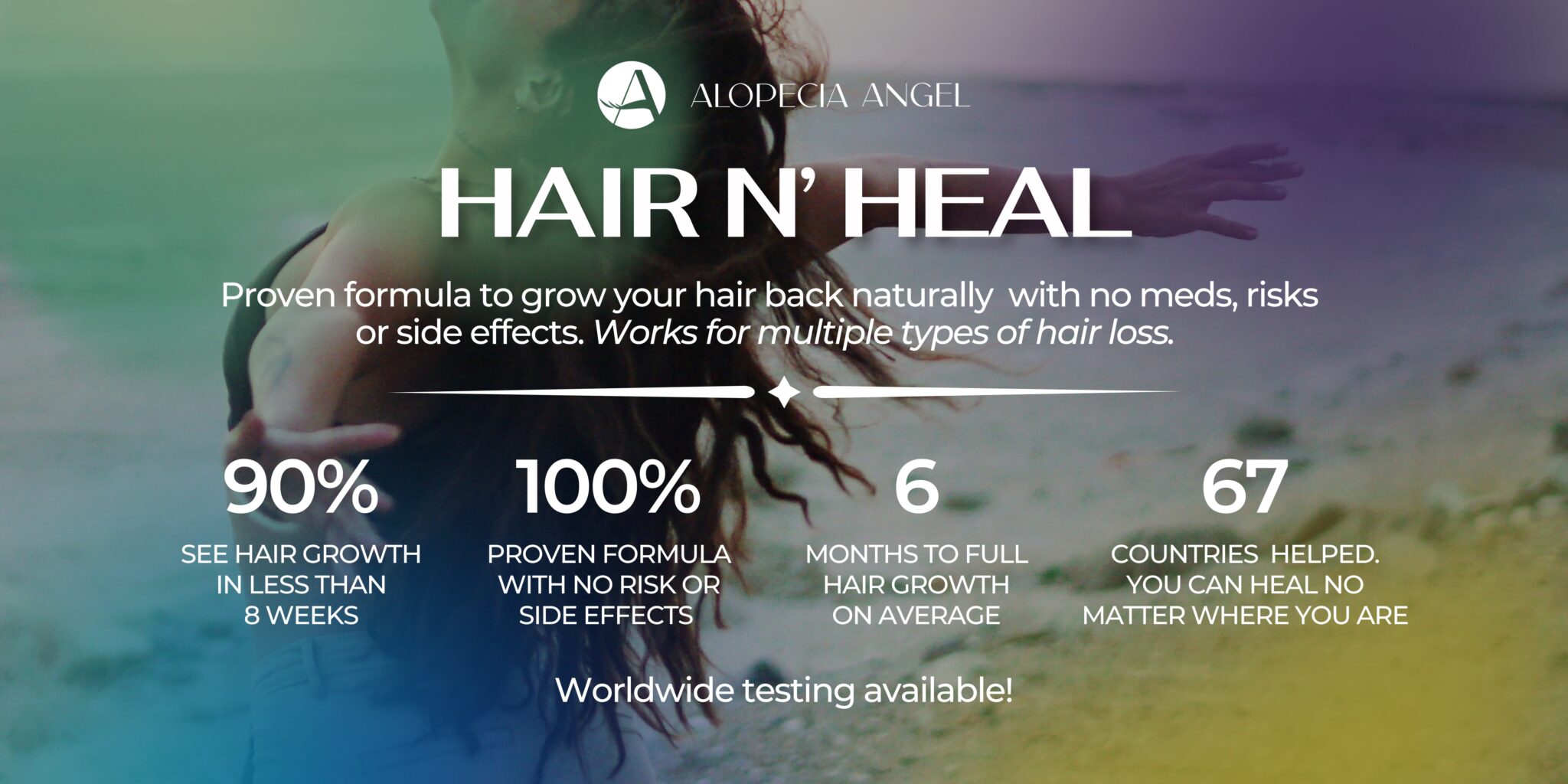
So if you know somebody who’s dealing with hair loss, who’s tried everything, and who’s just on the verge of giving up, who’s at their wits end, share this podcast with them because I’m happy to help them. We offer a free training, free downloads, PDFs. We also offer consultations, and we’re happy to get people up and running with hair growth in less time. 90% see hair growth in less than eight weeks, so today’s podcast episode is really about another research paper that I came across that I wanted to highlight because in certain points of hair loss and certain types, including scarring, alopecia, you have a tendency to see patterns. And of course, the research suggests that certain ethnicities and races do have more increased possibility towards one type of hair loss or another.
In this paper from Randy Dotinga, dated March 27th, 2026, research uncover the psychiatric toll of Alopecia areata on women. However, more importantly than just the title, it says that a pair of new studies highlight the mental health toll of Alopecia areata. Black women with the condition are at a greater risk for depression and anxiety than our women who are not black. And women overall with scarring forms are more likely than those with non-scarring forms to develop psychiatric disorders.
So going back to my initial entry into this podcast episode is that scarring alopecia tends to happen more prominently in the African American, black women community. You don’t tend to see this so much in men. I don’t hear about it. I don’t see it in research papers in men, but I do hear about it and see it with women on a regular basis. Now, we’ve helped many women, black women, African American women who are from Nigeria, who live in London or women who are African descent, but live in the Caribbean or Caribbean in general, but black and various types of scarring, alopecia, and they have seen results. Even other types of scarring alopecia with other races have also seen results inside the Hair N’ Heal program.
So that’s something that I wanna mention is that with scarring alopecia, it’s something like you wanna catch it sooner rather than later. You wanna take action sooner rather than later because once the follicles have scarred, it’s a 50-50 chance. And even now, actually, now that I’m thinking about it, there’s a client named Danielle and she’s on my social media, but she’s also on the YouTube and you could see where she with Scar and Alopecia, she has frontal fibrosing alopecia. With just five weeks, I believe she said, of doing the program, she already saw two and a half inches of hair growth, including in the areas, in the front areas of her forehead where she didn’t think she was gonna see hair growth happen or return. And so this is why you want to work sooner and quicker when you have a scarring alopecia diagnosis.
And even if you don’t, the best way to find out if you have a scarring alopecia diagnosis is to get a biopsy. However, if you have Alopecia areata or universalis or totalis, know that this is non-scarring. The scarring alopecia types are FFA frontal fibrosing, it’s C-C-C-A-L-L-P and many others. And so if you think or assume or maybe, have this instinct that you may have scarring alopecia, I would say get a biopsy to confirm. And even then, I’ve had clients who see five different doctors and get five different diagnoses. So many times they actually come to me, they’re like, look, I have five different diagnoses I’ve seen to, five different dermatologists and they can’t even tell me what I have.
We start the program and they see hair growth so many times it’s really a biology situation where we need to support the body versus having the concrete diagnosis because you can actually mitigate that diagnosis into healing and hair growth the sooner you act upon it. So this study goes on to say that the findings were presented here at the 2026 Skin of Color Society Scientific Symposium. Alopecia areata is more common in black women, which is actually something that I didn’t realize. A 2023 study found that black women are 1.35 times more likely than white women to develop Alopecia areata. Black women also experience traction alopecia in which the pulling of hair example and hairstyles such as cornrows and updos can cause hair loss.
Anxiety and depression rates in women with alopecia are also stronger in black women. For the study, Russell and a colleague surveyed 128 black women, 43.8% younger than 55 years, and 49 non-black women, 51% younger than 55 years who sought care for alopecia at a University of Chicago clinic. The women answered questions using surveys and evaluated quality of life, depressive symptoms and generalized anxiety. Black women had higher rates than non-black women of clinically significant symptoms of anxiety, 18% versus 8.2% respectively, and depression, 18.8% versus 10.2% respectively. Black women also had lower hair related quality of life and higher levels of anxiety symptoms.
There was no statistically significant difference in overall depression scores between the two groups. There’s a potential that black women are maybe under reporting their symptoms when it comes to depression because there’s also a general mental health stigma that exists in our world today. Regardless of race, women older than 55 years reported better quality of life in general. In another study, a medical student from Thomas Jefferson University Philadelphia, and colleagues analyzed retrospective data from two match cohorts of over 42,000 patients with non-scarring alopecia, and scarring alopecia compared with patients who had non-scarring alopecia. Those with scarring alopecia had higher rates of several psychiatric disorders, such as anxiety, sleep disturbances, depression, and insomnia. They noted that there was a higher percentage of black women in the scarring cohort than the non-scarring cohort.
She also highlighted study limitations such as the retrospective nature and reliance on medical coding and called for prospective research on this topic. So this just gives a little insight on how this can affect women of color a lot more severely mentally with their mental health and wellbeing much more than their counterparts. Not to say that it doesn’t affect women or children or even men at any level. I truly believe it affects us all potentially a little bit differently depending on our perspective. But let’s flip this around. Let’s look at the perspective of the possibility of healing. ‘Cause if we start looking at the possibility of healing, then this actually allows us to shift gears a little bit and allows us to see what is possible.
So for example, if you, the way I see healing, for example, with alopecia, with hair loss, having done this for over nine years with so many thousands of clients in 68 countries, 68 plus countries, is that I see healing, like doing something you’ve never done before. For example, when I was healing my own alopecia, I didn’t know how to do it either, and I did a lot of research, a lot of trial and error, and I finally got my results, and it’s been here for over nine years. The thing is, with you, you don’t have the same time or bandwidth that I had. I can almost guarantee it because I didn’t have a job. I was living off of my savings, and I spent literally 18 hours a day focused and dedicated to this, and it’s been that way since even after having my child.
So the thing is that when it comes to healing, we need to understand that it’s something we’ve never done. So think back to when you first started to learn how to ride a bike or learn how to drive or learn how to scuba dive in my case, or learn how to skydive or learn a new foreign language or even maybe a computer coding program or maybe something completely off topic, but maybe something that you’re interested in like art theory or watercolor painting or anything else in life that you want to be proficient in is we need to have a beginner’s mindset. And I think that once you have a beginner’s mindset, then you’re open to learning how to do this. Once you do, you see the results, and that’s what I think put my clients and myself in a different tier, in a different box versus other people who, one of two things, either they don’t know that healing naturally is possible or they’re just very confused with all the misinformation that’s out there, which is a high probability because there is a lot of misinformation.
There is a lot of people talking nonsense. A lot of even doctors who don’t know what to say and so they just fill it with nonsense and incorrect information. And this is hurting the client, the patient, the person going through hair loss. And this is my big thing is that we can heal naturally. We can put alopecia areata into remission. We can put alopecia universalis, totalis into remission or other types of hair loss and completely, and go into hair growth. It doesn’t matter how long you’ve had it, how many years, decades it’s been, how old you are, where you live, what race, ethnicity you are, or anything else. It just doesn’t matter. It’s anything else.
If you wanna learn how to drive a car, it’s there for you. There are schools that teach you how to drive if you wanna learn French. You can do this at any point in your life. You can be 88 years old or eight years old. You can learn how to garden. You can learn how to play the guitar, you can learn anything. But that’s just it. It takes a beginner’s mindset. So if you have the beginner’s mindset, if you are willing to learn, if you are willing to implement, if you are willing to be proficient in this new subject category, then you will see results, and I can guarantee that.
So I hope this inspires you to take action, to get in touch with us to start your healing process because the sooner the better. In my last week’s podcast, I talked about numerous situations and health problems that can arise when you let hair loss just be and don’t do anything about it. It only gets worse. You need to really tackle it. Start finding your root causes, start finding your triggers and get the healing happening in less time. You can do this and we can help. Thank you so much. I look forward to talking to you next week. And should you have any questions, please visit us @alopeciaangel.com. We’re here to help. And please share this and subscribe to our YouTube channel. Thank you so much. Take care