Today we’re going to talk about something very important: why your hair loss situation may not be improving—and what you can actually do about it.
Many people feel stuck. Not because they’re not trying, but because they don’t yet have clarity on what’s actually keeping them stuck. My goal today is to help you start seeing your situation more clearly so you can take the next step with confidence.
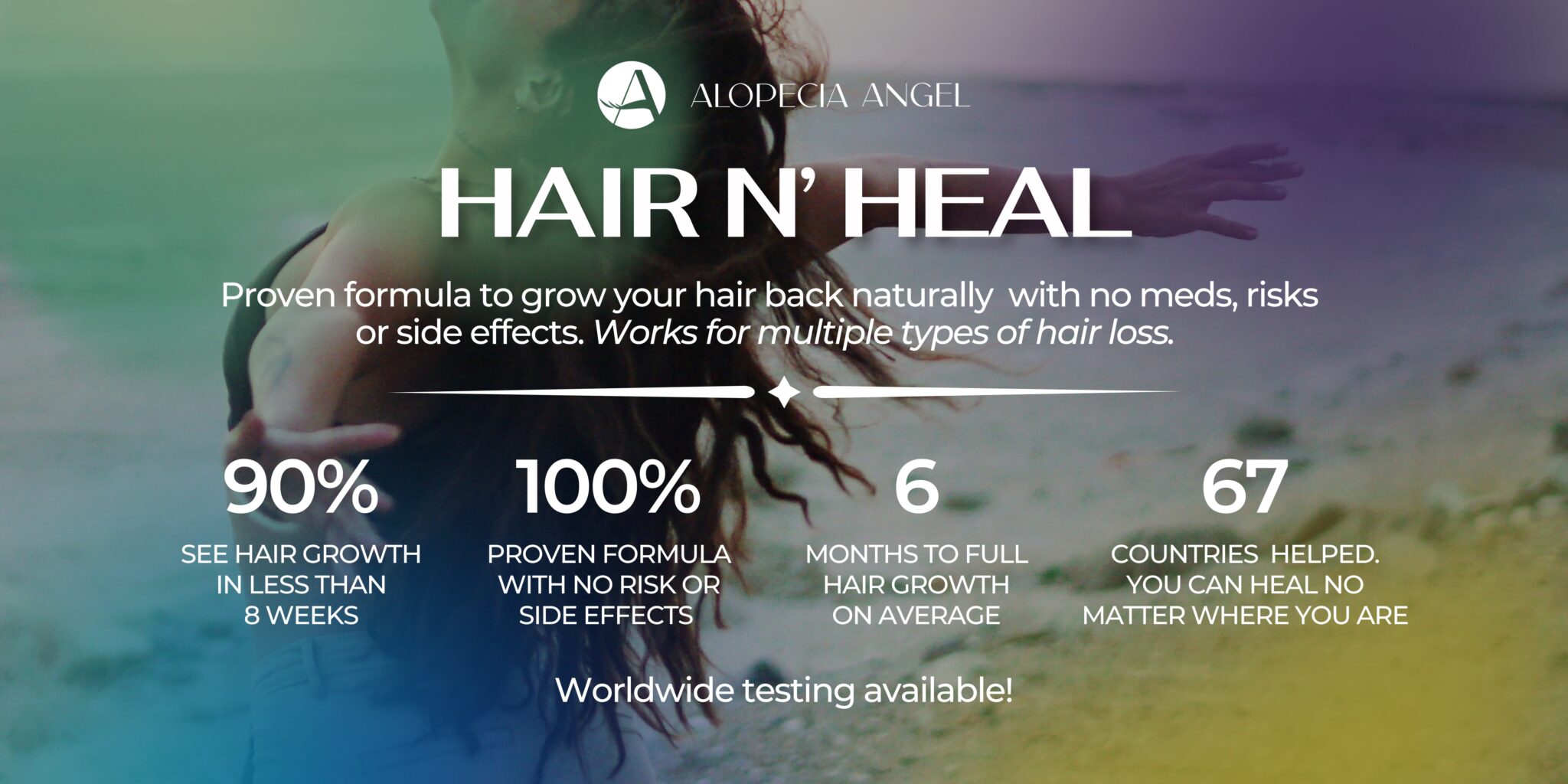
I’m speaking to you as someone who has worked with thousands of people in over 67 countries through the Alopecia Angel and the Hair N’ Heal approach, and also as someone who has personally gone through alopecia and recovered.
Let’s break this down.
First: what alopecia actually is
“Alopecia” is simply the medical term for hair loss. It includes many types, such as:
- Alopecia areata
- Telogen effluvium
- Diffuse thinning
- Postpartum hair loss
- Hormonal and thyroid-related hair loss
- Androgenic / female pattern hair loss
- And more
Even though the names are different, the pattern is the same: something in the system is out of balance.
Why you are not healing
If your hair loss feels stuck or unresponsive, it’s usually not because you’re “doing nothing.”
It’s because the strategy you’re using is incomplete.
Here are the most common reasons.
1. You think diet alone is enough
Diet is important. It is foundational. But it is not the full solution.
Hair loss is not a single-input problem. You can eat perfectly and still struggle if hormones, stress load, inflammation, sleep, or other systems are out of balance.
Diet supports healing—but it does not replace a full strategy.
2. You are not doing the right kind of testing (or any at all)
Some people have done testing. Others haven’t. But the bigger issue is what kind of testing is being done.
Most standard insurance-based labs are limited. They often focus on narrow markers rather than the full picture.
Take thyroid as an example:
Many people only test TSH. If it’s “normal,” they’re told everything is fine. But that is not a complete thyroid evaluation.
Even when TSH looks normal, other markers may show imbalance when a full panel is done.
This is where many people get stuck—they assume “normal labs” means optimal health.
It doesn’t.
3. You are trusting incomplete interpretations of your labs
Even when testing is done, the real issue is interpretation.
A lab result is only useful if someone knows how to connect the dots and translate it into action.
Without that, testing becomes data without direction.
4. You don’t have a personalized strategy
One of the biggest mistakes is using “one-size-fits-all” solutions:
- Generic supplement stacks
- Standard hair growth protocols
- Laser caps, PRP, or topical-only approaches
- Trending supplements or online recommendations
The problem is simple: your body is not generic.
What works broadly does not always work specifically.
Hair loss requires a targeted approach based on your unique patterns, history, and biology.
5. You haven’t uncovered your blind spots
Everyone has blind spots.
Often, you cannot see what is actually driving your hair loss until someone points it out.
It’s like having something in your teeth—you don’t notice it until someone tells you.
This is why many people struggle for years. They are working hard, but missing key pieces they cannot see on their own.
6. You may be working with the wrong support system
This is a sensitive but important truth.
Not every practitioner can take you from where you are to where you want to be.
Some can help you partially. Some can support basic improvement. But not everyone has the depth or experience to guide full reversal.
A key question to ask is:
Do they have proven results with cases like mine?
If the answer is unclear, or if you’ve seen no progress after several months, it may be time to reassess the approach.
7. You are missing multiple inputs—not just one fix
Healing is rarely about finding “the one missing thing.”
It is usually about multiple small imbalances working together.
Think of it like a recipe. Even a simple dish requires multiple ingredients. If one or two are missing, the result changes.
Hair growth works the same way. It is built through systems working together—not a single solution.
What to do next
If you are feeling stuck, here are the next steps:
Start by stepping back from random trial-and-error approaches. That is usually what keeps people stuck the longest.
Instead, focus on:
- Understanding your full pattern
- Identifying blind spots
- Getting the right type of testing (if needed)
- Working with someone who can interpret and guide clearly
- Moving away from generic solutions
Inside the Hair N’ Heal framework, this is exactly what is mapped out through structured intake, analysis, and individualized planning.
A final perspective shift
Hair loss is not just a cosmetic issue.
It is a signal.
And when you treat it as a signal—not just a symptom—you start to see your health differently.
Healing is possible, but it requires more than effort. It requires direction, clarity, and the willingness to adjust your approach when something is not working.
If you take nothing else from this, take this:
You don’t need more guessing. You need a clearer map.